
Jamaican Currency: Complete Guide to JMD, Notes, Coins, USD and Travel Money
13 min read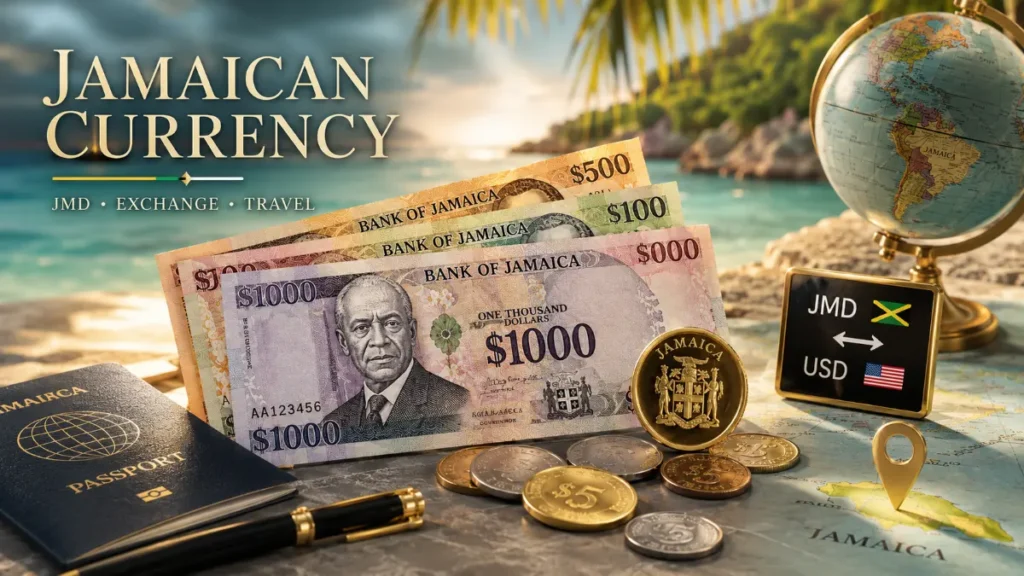
If you are researching Jamaican currency, the essential answer is straightforward: Jamaica’s currency is the Jamaican dollar, identified internationally by the code JMD. The Bank of Jamaica (BOJ) issues Jamaica’s physical banknotes and coins, while JAM-DEX is the country’s central bank digital currency and is also legal tender. For travelers, one distinction matters most: Jamaican dollars are the local currency, while U.S. dollars are also widely used in many tourist-oriented businesses.
The current physical currency consists of six banknote denominations-J$50, J$100, J$500, J$1,000, J$2,000 and J$5,000-and four coins-J$1, J$5, J$10 and J$20. Jamaica has also undergone important recent currency changes: a polymer banknote series entered circulation in 2023, and the previous cotton banknotes ceased to be legal tender on July 1, 2025.
What Is Jamaican Currency?
The Jamaican dollar is Jamaica’s national currency and the denomination used for everyday prices and payments. Its international currency code is JMD, while the currency is commonly represented by $ or J$.
The Bank of Jamaica is responsible for issuing Jamaica’s physical currency. Its current currency information identifies six banknotes and four circulating coins.
There is an important modern distinction between the country’s currency and its physical cash. JAM-DEX, issued by the Bank of Jamaica, is a central bank digital currency. BOJ states that it is legal tender and can be exchanged one-for-one with Jamaican banknotes and coins.
That means an accurate explanation of Jamaican money today should include both its physical cash and its digital-currency component.
Jamaican Dollar Symbol and ISO Code
The Jamaican dollar can be written as $ or J$.
Because many currencies use the dollar sign, J$ is especially useful when Jamaican and U.S. dollars appear in the same context.
For example:
- J$500 means 500 Jamaican dollars.
- US$500 means 500 U.S. dollars.
- JMD is the international three-letter currency code for the Jamaican dollar.
A local price may simply display “$” when there is no realistic ambiguity. If a tourist business quotes prices in both currencies, however, it is worth confirming which dollar is being used.
Is the Jamaican Dollar Divided Into Cents?
Yes. The Jamaican dollar is divided into 100 cents, but cent coins are no longer part of Jamaica’s current circulating coinage.
The Bank of Jamaica records that the 1¢, 10¢, and 25¢ coins were demonetized on February 15, 2018. Today’s circulating coins are all denominated in whole Jamaican dollars.
This is a useful distinction when reading older information. A historical reference to Jamaican cents does not mean those coins are still accepted for ordinary purchases.
Current Jamaican Currency Denominations
The current physical Jamaican currency can be divided into two groups: four circulating coins and six polymer banknotes.
| Denomination | Type | Current status |
| J$1 | Coin | In circulation |
| J$5 | Coin | In circulation |
| J$10 | Coin | In circulation |
| J$20 | Coin | In circulation |
| J$50 | Banknote | Current polymer note |
| J$100 | Banknote | Current polymer note |
| J$500 | Banknote | Current polymer note |
| J$1,000 | Banknote | Current polymer note |
| J$2,000 | Banknote | Current polymer note |
| J$5,000 | Banknote | Current polymer note |
The Bank of Jamaica confirms the six current banknote denominations and the four current coin denominations.
Current Jamaican Banknotes
Jamaica currently uses these six banknotes:
- J$50
- J$100
- J$500
- J$1,000
- J$2,000
- J$5,000
The current series is made from polymer rather than the cotton-based substrate used for the previous series. BOJ introduced the upgraded notes to improve security and accessibility as well as durability.
The notes also contain tactile and visual features intended to make denominations easier to distinguish and to strengthen protection against counterfeiting.
The J$2,000 Banknote
The J$2,000 note is the newest denomination in Jamaica’s current banknote lineup.
The Bank of Jamaica’s currency timeline records the introduction of the J$2,000 note on June 15, 2023, alongside the new polymer series. The same series introduced updated versions of the J$50, J$100, J$500, J$1,000, and J$5,000 notes.
This is particularly important for anyone using an older Jamaica travel guide. A denomination list published before 2023 may not include the J$2,000 note.
Current Jamaican Coins
The current coins are:
- J$1
- J$5
- J$10
- J$20
Older Jamaican currency references may also mention cent coins. Those should be treated as historical information because the 1¢, 10¢ and 25¢ coins were demonetized in 2018.
What Happened to the Old Jamaican Banknotes?
One of the biggest recent changes to Jamaican currency was the replacement of the old cotton banknotes with polymer notes.
The Bank of Jamaica announced that the old cotton J$50, J$100, J$500, J$1,000 and J$5,000 notes ceased to be legal tender on July 1, 2025. They therefore cannot be used for ordinary purchases after that date. BOJ also states that it will continue to redeem the old cotton notes for their face value indefinitely.
This creates an important difference between legal tender and redeemability.
An old note may still be redeemable through the Bank of Jamaica even though a retailer is no longer required to accept it as payment.
For travelers, collectors, or anyone who finds an older Jamaican note, checking its current status with BOJ is safer than relying on an old travel article.
Jamaican Currency History: From Pounds to Dollars
Jamaica’s modern dollar system began with the country’s transition to decimal currency in 1969.
Before decimalization, Jamaica used a pound-based system connected to the British monetary tradition. Jamaica became independent from Great Britain in 1962, but the country’s notes and coins did not immediately change as a result of independence.
The major monetary transition came seven years later.
When Did Jamaica Introduce the Jamaican Dollar?
Jamaica adopted its decimal currency system on September 8, 1969, using dollars and cents. The Jamaican dollar replaced the previous pound-based monetary system at a conversion of J$1 for 10 shillings, meaning two Jamaican dollars equaled one Jamaican pound.
The change replaced the older pounds, shillings, and pence structure with a decimal system that was easier to calculate for everyday transactions.
The Bank of Jamaica had already been established in 1960, so the decimalization of 1969 took place within an established national central-banking framework.
Important Milestones in Jamaican Currency
Several changes help explain how today’s currency system developed:
| Year | Currency development |
| 1960 | Bank of Jamaica established |
| 1962 | Jamaica gained independence; no immediate change to notes and coins |
| 1969 | Jamaica changed to a decimal dollar-and-cents system |
| 1994 | J$500 banknote introduced |
| 2000 | J$1,000 banknote introduced; J$20 note replaced by a coin |
| 2009 | J$5,000 banknote introduced |
| 2018 | 1¢, 10¢ and 25¢ coins demonetized |
| 2023 | New polymer banknote series entered circulation, including J$2,000 |
| 2025 | Old cotton J$50, J$100, J$500, J$1,000 and J$5,000 notes ceased to be legal tender |
The Bank of Jamaica’s official currency timeline confirms these major transitions.
What Is the Jamaican Dollar Exchange Rate?
There is no permanent JMD-to-USD exchange rate because foreign-exchange values change over time.
For a current, dated reference, the Bank of Jamaica’s published rates for August 28, 2026 showed the U.S. dollar at approximately J$157.09 buying and J$159.23 selling. These are BOJ reference market rates for that date, not a guaranteed rate for every cash exchange, card transaction, or ATM withdrawal.
BOJ’s monthly weighted-average data also shows how rates change over time. For July 2026, the USD weighted-average rates were approximately J$159.27 selling and J$157.53 buying.
The difference between a published reference rate and the amount you actually receive can result from:
- The provider’s buying or selling rate
- Exchange commissions or service charges
- ATM charges
- Card issuer fees
- Merchant-set conversion rates
- The type of transaction being performed
For that reason, an online exchange-rate figure should be treated as a reference rather than a promise of the final amount you will receive.
How Should You Check the Current JMD Rate?
For a significant exchange or transfer, start with the Bank of Jamaica’s latest foreign-exchange information.
Then compare the actual rate and charges offered by the bank, exchange provider, card issuer, or other service you intend to use.
A rate from an old travel article can quickly become outdated. Even a rate published earlier in the same month may no longer represent the rate available when you exchange your money.
Jamaican Currency vs. U.S. Dollars in Jamaica
For visitors, the relationship between JMD and USD is often more important than the history of the currency.
The Jamaican dollar is the local currency, but U.S. dollars are also widely accepted in many tourist-oriented businesses. U.S. government trade guidance notes that U.S. dollars are commonly accepted and that prices in tourist areas may be quoted in either currency.
That does not mean every Jamaican business accepts USD or that a merchant’s USD conversion will necessarily be the same as the current market rate.
| Situation | Usually practical approach | Reason |
| Hotels and resorts | JMD or USD | Tourist-oriented businesses commonly handle USD |
| Organized excursions | Use the currency quoted by the operator | The quoted price is what matters |
| Local shops | JMD | Local prices are generally expressed in Jamaican dollars |
| Small purchases | JMD | Easier for everyday local transactions |
| Local transportation | JMD | Local currency is the safer option |
| Tips | Small JMD or appropriate USD notes | Smaller denominations are easier to use |
| Tourist-area shopping | Either, after checking the price | Compare the actual conversion |
The best currency is therefore not determined simply by whether a business accepts U.S. dollars.
How to Compare a USD Price With a JMD Price
Suppose a merchant gives you both prices for the same item.
Do not ask only, “Do you accept U.S. dollars?”
Instead, compare the two prices mathematically.
If an item costs J$3,000 and the merchant asks for US$20, the implied exchange rate is:
J$3,000 ÷ US$20 = J$150 per US$1
You can then compare that implied rate with a current reference rate and decide whether the quoted USD price is reasonable.
The same approach works in reverse when a business quotes a price in USD but tells you the JMD amount.
This simple calculation is often more useful than memorizing a general rule about whether USD or JMD is “better.”
Can You Use U.S. Dollars in Jamaica?
Yes. U.S. dollars are widely accepted in many businesses that serve international visitors, particularly in tourist-oriented areas.
However, acceptance varies.
A local merchant may:
- Accept only JMD.
- Accept USD and give change in JMD.
- Quote separate JMD and USD prices.
- Accept cards but not cash in a particular currency.
If you pay in USD for an item priced in Jamaican dollars, check the implied conversion rate before handing over the money.
For small local purchases, carrying some JMD is usually the simplest way to avoid unnecessary conversion questions.
Should Travelers Carry Jamaican Dollars?
Yes. Even travelers who plan to use cards or U.S. dollars can benefit from having some JMD cash.
JMD can be useful when:
- A small business does not accept cards.
- A merchant does not accept USD.
- You need smaller denominations.
- A locally priced service is quoted in Jamaican dollars.
- A card terminal is unavailable.
- You want to avoid relying on a merchant’s own USD conversion.
There is no universally correct amount of cash to carry. Your needs will depend on where you are staying, how much local transportation you use, where you eat, and whether your itinerary takes you beyond larger tourist businesses.
The more useful principle is payment redundancy: do not depend entirely on one card, one currency, or one payment method.
Where Should You Exchange Money in Jamaica?
Use established banks or authorized foreign-exchange providers, and compare the net amount you receive rather than looking at a headline rate alone.
Before exchanging a significant amount, check:
- The quoted buying or selling rate.
- Any commission or service charge.
- The final JMD amount you will receive.
- Whether the quoted rate applies to cash, transfers or another transaction type.
Convenience does not necessarily mean the same exchange value everywhere. A hotel desk, airport counter, bank and authorized exchange provider can have different rates or fees.
Rather than assuming one type of provider is always cheapest, compare the actual transaction you are about to make.
Using ATMs and Cards in Jamaica
Cards can be useful at many established businesses, including hotels, larger restaurants, and other tourist-oriented locations. Cash remains useful for smaller transactions and places where card acceptance is limited.
A sensible travel setup is:
- One primary debit or credit card
- A backup payment method
- Some Jamaican-dollar cash
- A small emergency cash reserve stored separately
Before withdrawing money, read the ATM’s on-screen information and check your own bank’s international transaction terms.
Pay particular attention to currency conversion choices. If an ATM or payment terminal offers to convert a transaction into your home currency, review the exchange rate and any associated charges before accepting the conversion.
ATM availability and payment acceptance can vary by location, so travelers visiting less-touristed areas should not assume the same options will be available everywhere.
How Much Cash Can You Bring Into Jamaica?
Jamaica has a declaration requirement for travelers carrying substantial amounts of currency.
The Jamaica Customs Agency states that travelers must declare currencies of US$10,000 or more, or the equivalent in another currency, to a Customs Officer.
This is a declaration requirement, not a statement that carrying that amount is automatically prohibited.
If you plan to travel with a large amount of cash, check the latest Jamaica Customs instructions before departure. The exact procedures, forms, and enforcement requirements should be confirmed with the relevant authority rather than taken from an old travel article.
How to Recognize Genuine Jamaican Banknotes
The Bank of Jamaica recommends using a “Feel, Look, Tilt, and Check” approach when checking its banknotes.
Feel the Note
The polymer notes have a distinct polymer feel, and BOJ incorporates tactile features intended to help visually impaired users identify the denominations.
Look for Security Features
The notes contain transparent-window and other security features that are difficult to reproduce accurately. BOJ provides denomination-specific guidance for identifying them.
Tilt the Note
Some security elements change or move visually when the note is tilted. The exact feature varies by denomination, so the BOJ’s official banknote information is the best reference when checking a specific note.
Check the Note
BOJ also describes additional security elements visible under ultraviolet light.
If a note appears suspicious, compare it with official BOJ information rather than relying on a photograph from an unofficial website.
What Is JAM-DEX?
JAM-DEX is Jamaica’s central bank digital currency, or CBDC.
It is issued by the Bank of Jamaica and is different from a privately issued cryptocurrency. BOJ explains that CBDC is digital money issued by the central bank, stored in a CBDC wallet rather than an ordinary bank account, and exchangeable one-for-one with physical banknotes and coins.
JAM-DEX became legal tender following amendments to the Bank of Jamaica Act in 2022. Those amendments established BOJ as the sole authority to issue Jamaica’s CBDC.
For most tourists, understanding JMD cash remains the priority. But JAM-DEX is important because it shows how Jamaica’s monetary system now includes both physical and digital forms of central-bank money.
Why Does the Jamaican Dollar’s Value Change?
The JMD-to-USD exchange rate is influenced by changing economic and financial conditions rather than being permanently fixed.
The Bank of Jamaica publishes foreign-exchange data and educational material explaining the factors that influence exchange rates.
For travelers, the practical takeaway is more important than trying to memorize the long-term history of the exchange rate:
Do not budget a current trip using an exchange rate from an old vacation or an old article.
Instead, check the latest available rate before exchanging money and remember that the rate you actually receive may differ because of transaction-specific charges or conversion methods.
Read more: Jamaican Currency: Complete Guide to JMD, Notes, Coins, USD and Travel Money
What Has Changed in Jamaican Currency Recently?
Three changes are particularly important if you are using older information.
1. Cent Coins Were Demonetized
The 1¢, 10¢ and 25¢ coins ceased to be legal tender on February 15, 2018.
2. The Polymer Series and J$2,000 Note Were Introduced
The current polymer banknotes, including the new J$2,000 denomination, entered circulation on June 15, 2023.
3. Old Cotton Notes Ceased to Be Legal Tender
The old cotton J$50, J$100, J$500, J$1,000 and J$5,000 notes ceased to be legal tender on July 1, 2025. BOJ continues to redeem those notes for face value indefinitely.
These changes are why the publication date of a Jamaican currency guide matters. A page written before 2023 may have an incomplete denomination list, while one written before July 2025 may incorrectly describe cotton notes as current legal tender.
Frequently Asked Questions
What is the official currency of Jamaica?
The official currency is the Jamaican dollar, with the international code JMD. Jamaica also has JAM-DEX, a central bank digital currency issued by the Bank of Jamaica that is legal tender.
What is the symbol for Jamaican currency?
The Jamaican dollar is commonly represented by $ or J$. J$ is useful when it needs to be distinguished from the U.S. dollar.
What Jamaican banknotes are currently in circulation?
The current banknotes are J$50, J$100, J$500, J$1,000, J$2,000 and J$5,000. They are part of Jamaica’s current polymer banknote series.
What coins does Jamaica use?
The current circulating coins are J$1, J$5, J$10 and J$20. The 1¢, 10¢ and 25¢ coins were demonetized in 2018.
Can I use U.S. dollars in Jamaica?
Yes. U.S. dollars are widely accepted in many tourist-oriented businesses, although acceptance varies. The Jamaican dollar remains the local currency, so having some JMD is useful.
What is the current JMD-to-USD exchange rate?
Exchange rates change, so there is no permanent figure. As an official reference, BOJ listed the U.S. dollar at J$157.0944 buying and J$159.2314 selling on August 28, 2026. Check the latest BOJ rate before a significant transaction.
When did Jamaica introduce the Jamaican dollar?
Jamaica adopted its decimal dollar-and-cents system on September 8, 1969, replacing the previous pound-based system.
Are old Jamaican cotton banknotes still legal tender?
No. The old cotton J$50, J$100, J$500, J$1,000 and J$5,000 notes ceased to be legal tender on July 1, 2025. BOJ says it will continue to redeem them for face value indefinitely.
How much cash can I bring into Jamaica without declaring it?
Jamaica Customs requires travelers to declare currencies totaling US$10,000 or more, or the equivalent in another currency. Check current Customs instructions before traveling with a large amount of cash.
What is JAM-DEX?
JAM-DEX is Jamaica’s central bank digital currency. It is issued by the Bank of Jamaica, is legal tender, and can be exchanged one-for-one with physical Jamaican notes and coins. It is not the same as a privately issued cryptocurrency.
Final Takeaway
The simplest way to understand Jamaican currency is to start with the Jamaican dollar, or JMD. Today’s physical currency consists of six polymer banknotes-J$50, J$100, J$500, J$1,000, J$2,000 and J$5,000-and four coins-J$1, J$5, J$10 and J$20. The older cotton banknotes stopped being legal tender in 2025, while JAM-DEX provides Jamaica with a digital form of central-bank money.
For travelers, the smartest approach is not to choose between JMD and USD based on a blanket rule. U.S. dollars can be convenient in tourist-oriented businesses, while Jamaican dollars are useful for local purchases and situations where a merchant’s USD conversion may not be favorable. Compare the actual price and exchange rate whenever both currencies are offered.
Most importantly, use current information. Jamaican currency has changed substantially in recent years, and the July 2025 withdrawal of the old cotton notes means that some older travel guides are now outdated. For exchange rates and currency-status questions, the Bank of Jamaica remains the most authoritative source.