What Is Kataifi? The Complete Guide to the Crispy Thread Pastry
11 min read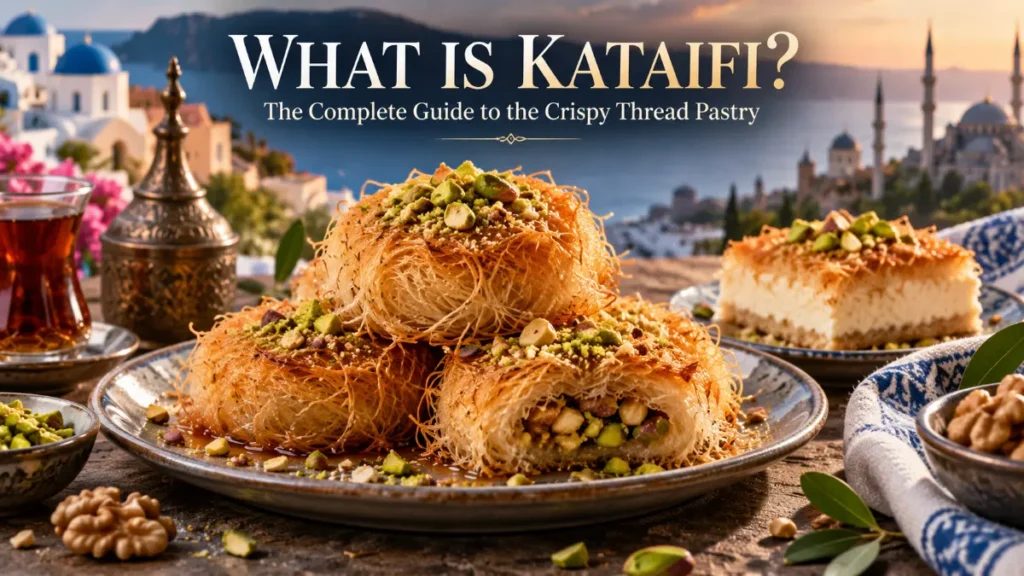
Kataifi is a fine, thread-like pastry used across Greek, Turkish, Middle Eastern, Balkan, and Eastern Mediterranean culinary traditions. Unlike pasta, it is made from a thin flour-based batter that is formed into delicate strands. Those strands can then be buttered or oiled, baked or fried, and combined with nuts, cheese, cream, syrup, chocolate, or savory fillings.
That simple explanation clears up the biggest misconception: kataifi is not a noodle, even though its appearance can resemble vermicelli or angel-hair pasta.
It is also more useful to think of kataifi as a pastry form rather than one single dessert. The same type of fine strands appears in Greek nut-filled pastries, Turkish tel kadayıf preparations, cheese-based knafeh and künefe, and modern desserts inspired by the viral Dubai chocolate trend.
What Is Kataifi Made From?
At its most basic, kataifi begins with a thin batter based primarily on wheat flour and water. Commercial products may also contain starch, oil, salt, vital wheat gluten, or other ingredients, so the exact formulation varies between manufacturers.
The batter is transformed into strands rather than sheets. That structural difference is central to everything that happens later.
A typical commercial product, for example, may list wheat flour, water, modified food starch, corn starch, canola oil, salt, and vital wheat gluten. Therefore, anyone with allergies or dietary restrictions should check the specific package rather than relying on a generic ingredient list.
Why the Ingredients Matter
The pastry itself is relatively neutral in flavor. Its real strength is its structure.
Once coated with butter or another fat and exposed to heat, the extremely thin strands can lose moisture and brown across a large amount of surface area. This produces the delicate crunch associated with well-cooked kataifi.
The strands can then absorb syrup or sit alongside creamy fillings without completely disappearing into them.
That combination of crisp structure and moisture absorption is what makes the pastry unusually versatile.
How Is Kataifi Made?
The traditional production principle is surprisingly different from making ordinary phyllo.
Instead of rolling a dough into sheets, a thin batter is passed through very small openings and streamed onto a heated surface. The batter sets rapidly into fine strands, which are gathered while they remain flexible.
The basic process is:
- Prepare a smooth, thin batter.
- Pass the batter through fine openings.
- Stream it onto a heated surface.
- Allow the strands to set.
- Collect the strands before they become deeply browned.
- Cool or package them for later use.
Modern commercial producers use specialized equipment to create consistent strands, while homemade versions attempt to reproduce the same principle with a squeeze bottle, piping device, or another fine dispenser.
Why the Strands Are So Fine
The thin structure is not merely decorative.
A bundle of fine strands contains far more exposed surface than a solid piece of dough of similar weight. When the pastry is coated with butter or oil and cooked, that geometry encourages browning and crisping.
It also creates thousands of small spaces where syrup, cream, melted cheese, or other flavors can interact with the pastry.
That is why substituting a sheet pastry can produce something tasty but structurally different.
Is Kataifi the Same as Shredded Phyllo?
This is one of the most confusing points in online recipes.
You will sometimes see kataifi described as “shredded Phyllo,” and some Greek culinary sources use that description because it helps explain the ingredient to people familiar with phyllo. However, the terms are not technically identical in every production context.
Traditional phyllo is formed into thin sheets. Kataifi is characterized by fine strands.
| Feature | Kataifi | Phyllo / Filo |
| Shape | Fine strands | Thin sheets |
| Basic production | Thin batter formed into threads | Dough stretched or rolled into sheets |
| Appearance | Vermicelli-like | Paper-thin sheets |
| Texture after cooking | Fine, fragmented crunch | Layered, flaky crunch |
| Common sweet applications | Knafeh, kadayıf, nut pastries | Baklava, layered pastries |
| Common savory applications | Coatings, pies, wraps | Börek, pies, parcels |
| Direct substitute? | Usually no | Usually no |
There is therefore a useful distinction between culinary shorthand and technical description. Calling kataifi shredded phyllo may help a shopper recognize what they are looking for, but it should not imply that every product is literally produced by shredding finished phyllo sheets.
What Is the Difference Between Kataifi and Kadayif?
The terminology becomes more complicated because different languages and cuisines use related words.
You may encounter:
- Kataifi
- Kataïfi
- Kadaifi
- Kadayif
- Kadayıf
- Tel kadayıf
- Kunafa
- Knafeh
- Künefe
These terms overlap, but they should not automatically be treated as exact synonyms.
Kataifi is a common Greek form associated with the thread pastry and desserts made from it.
Kadayıf is a Turkish term used for a broader family of preparations, while tel kadayıf specifically emphasizes the fine, thread-like form.
Knafeh and kunafa generally refer to finished dessert traditions in which related thread pastry may be used, although regional recipes vary considerably.
This is why the best way to identify a product is to look at the actual pastry and the preparation described on the package or recipe, rather than relying only on transliteration.
Kataifi, Knafeh, and Künefe: What Is the Relationship?
These foods are closely related but are not simply three names for one standardized dish.
Knafeh encompasses several regional preparations. Some use fine thread pastry, while others use different forms of pastry or semolina-based mixtures. Cheese-filled versions are particularly well known.
Künefe is a Turkish preparation closely related to the wider knafeh family. It is especially associated with Hatay and is commonly prepared with thread pastry and melting cheese, then served hot with syrup and pistachios.
The important distinction is:
Kataifi describes a pastry form or Greek-style preparations; knafeh and künefe describe broader finished-dish traditions.
That distinction prevents a great deal of confusion when comparing recipes.
What Does Kataifi Taste Like?
The raw pastry has a mild flavor. Once cooked, its character comes mainly from browning, fat, fillings, and whatever syrup or seasoning accompanies it.
A classic nut-filled version can have:
- buttery notes
- toasted pastry flavor
- walnut or pistachio richness
- cinnamon or clove
- citrus from syrup
- floral notes from orange blossom or rose water
Cheese-based versions shift the balance toward salty, creamy, and sweet flavors.
Modern chocolate applications use the pastry differently. Instead of soaking it in syrup, cooks may toast and chop the strands before combining them with pistachio cream or another filling.
Why Does Kataifi Get So Crispy?
The answer is largely structural.
The pastry consists of extremely thin threads. When those threads are spread apart and coated with fat, heat reaches a large amount of exposed surface.
As moisture leaves and browning develops, the strands become crisp.
The effect is particularly noticeable when the pastry is arranged loosely rather than compressed into a dense mass. Proper browning creates the crunchy foundation; syrup or moist fillings can then soften selected parts without necessarily destroying the entire texture.
This is also why underbaking can produce a disappointing result. If the strands never become properly golden and crisp, they have less structural strength when syrup or cream is introduced.
How Is Kataifi Used?
Although syrup-soaked nut desserts are among the best-known applications, the pastry is considerably more versatile.
Nut-Filled Greek-Style Pastries
Butter-coated strands can be wrapped around chopped walnuts, pistachios, or almonds, shaped into rolls or nests, baked until golden, and finished with syrup.
This is the version many people encounter at Greek bakeries and restaurants.
Turkish Tel Kadayıf
Tel kadayıf is used in several Turkish preparations, often with nuts, syrup, and regional dairy accompaniments.
The word kadayıf itself covers a broader family, so it is important not to assume that every Turkish dessert carrying the name uses exactly the same pastry.
Knafeh and Cheese-Based Desserts
Thread pastry can be combined with mild or salty cheese, syrup, and pistachios in different regional forms of knafeh.
The balance can be very different from Greek nut-filled pastries: instead of relying primarily on nuts for texture and richness, the dessert may emphasize the contrast between crisp pastry and soft, melted cheese.
Ekmek Kataifi
Greek ekmek kataifi demonstrates another direction. The baked, syruped pastry forms a base for custard or cream, with whipped cream and pistachios often added above it.
It shows that kataifi does not have to be rolled around a nut filling to be recognizably part of the Greek dessert tradition.
Savory Applications
The pastry also works outside desserts.
Its fine strands can be used as a crisp coating or wrapper for savory ingredients, including seafood and cheese, and contemporary cooks use it in savory pies and other dishes.
That versatility is one reason it should be understood as a pastry ingredient rather than merely a syrup dessert.
Where Does Kataifi Come From?
There is no responsible one-sentence answer such as “Kataifi was invented by Greece” or “Kataifi was invented by Türkiye.”
The pastry belongs to a much broader culinary history spanning Arabic, Ottoman, Greek, Turkish, Levantine, Balkan, and neighboring food traditions.
Historical accounts of related knafeh and thread-pastry traditions connect them with medieval Arabic culinary writing and later Ottoman culinary developments. Smithsonian reporting on knafeh notes a 13th-century Baghdad cookbook and later Ottoman adaptations involving pastry batter formed into strands.
That history also explains why modern names overlap.
Culinary traditions do not always respect today’s national borders. Recipes travel through migration, trade, religious pilgrimage, imperial administration, restaurants, family traditions, and commercial food production.
The most accurate description is therefore that modern kataifi and related thread pastries developed within an interconnected regional culinary history.
How to Buy Kataifi
Look for it in Greek, Turkish, Middle Eastern, Balkan, or international grocery stores.
It may be sold:
- fresh
- refrigerated
- frozen
- under the names kataifi, kadaifi, kadayıf, or tel kadayıf
Always check the package description if a recipe requires a particular form.
Fresh vs. Frozen Pastry
Frozen pastry is often the most convenient option for home cooks.
Thaw it according to the manufacturer’s instructions rather than assuming that every product should be thawed in the same way.
Once opened, the fine strands dry quickly. During assembly, keeping unused pastry covered helps preserve its flexibility.
Does Kataifi Contain Gluten?
Traditional wheat-based kataifi is not gluten-free.
Commercial formulations commonly contain wheat flour, and some products also contain vital wheat gluten. People with celiac disease, wheat allergy, or gluten sensitivity should check the specific package and cross-contact information.
The same caution applies to finished desserts. Butter, cheese, cream, nuts, and other ingredients can be added depending on the recipe.
Can You Make Kataifi at Home?
Yes, but making the strands consistently is considerably more demanding than using prepared pastry.
The batter must be thin enough to produce fine continuous threads, while the cooking surface needs to be hot enough to set the strands without browning them prematurely.
For most home cooks, commercially prepared pastry is the more practical choice.
Making the strands from scratch is worthwhile primarily when you want to learn the traditional technique, experiment with pastry production, or cannot obtain prepared kataifi locally.
Kataifi vs. Baklava
Kataifi and Baklava share an important family resemblance: both can combine pastry, nuts, butter, and syrup.
The structural difference is more useful than the flavor comparison.
Baklava normally relies on layers of thin phyllo sheets.
Kataifi relies on fine pastry strands.
That difference creates a different mouthfeel. Baklava produces recognizable flaky layers, while kataifi produces a more fragmented, thread-by-thread crunch.
So it is better to think of them as related syrup pastries rather than versions of the same dessert.
Why Is Kataifi Suddenly Associated With Dubai Chocolate?
The recent Dubai chocolate phenomenon introduced the pastry to a much wider international audience.
The best-known style combines chocolate with pistachio-based filling and crispy kadayif or kataifi pastry. Associated Press reported that the trend spread rapidly beyond the original bar into croissants, milkshakes, parfaits, ice creams, and other products.
The combination works because the pastry supplies something the other ingredients lack: a strong crisp texture.
Chocolate is smooth and rich. Pistachio filling is creamy and fatty. Toasted pastry introduces dry, brittle pieces that interrupt that softness.
The trend is therefore not the invention of a new pastry. It is a modern use of an established ingredient.
The Bottom Line
Kataifi is a fine thread pastry made from a thin wheat-based batter and cooked into delicate strands. It resembles noodles visually but belongs to the pastry family.
Its importance becomes clearer once the terminology is separated. The pastry can appear as Greek kataifi, Turkish tel kadayıf, or as part of regional knafeh and künefe preparations. It can be paired with nuts, cheese, cream, syrup, chocolate, or savory fillings.
Its recent appearance in Dubai chocolate has made it globally recognizable, but the pastry itself has a much longer culinary history.
For a first encounter, the best question is not “Which country owns kataifi?” but rather: Which pastry form and finished dish am I looking at? That approach produces a much more accurate understanding of this remarkably adaptable ingredient.
Read more: Kataifi is a fine, thread-like pastry used across Greek, Turkish, Middle Eastern.
Frequently Asked Questions
Is kataifi a type of pasta?
No. It may resemble vermicelli or angel-hair pasta, but it is a pastry made from a thin flour-based batter and formed into fine strands. It is normally baked or fried rather than boiled.
Is kataifi the same as shredded phyllo?
The terms are sometimes used interchangeably in culinary descriptions, but technically they can refer to different production methods. Kataifi is characterized by fine strands, while traditional phyllo is produced as sheets.
What is kataifi used for?
It is used in Greek and Turkish pastries, knafeh and related cheese desserts, syrup-soaked nut sweets, custard desserts, savory dishes, and modern chocolate and pistachio confections.
Is kataifi the same as kadayıf?
They are closely related terms, particularly for fine thread pastry, but usage varies by region. Kataifi is common in Greek contexts, while kadayıf and tel kadayıf are associated with Turkish usage.
Is kataifi gluten-free?
Traditional wheat-based kataifi is not gluten-free. Commercial products should be checked individually because ingredients and manufacturing conditions vary.
What does kataifi taste like?
The pastry itself has a mild flavor. Once cooked, it becomes buttery, toasted, and crisp, while its final taste depends on fillings, syrup, spices, cheese, cream, or other ingredients.
What is the difference between kataifi and knafeh?
Kataifi refers primarily to a fine thread pastry or Greek preparations made from it. Knafeh is a broader finished-dessert tradition that can use thread pastry along with cheese, syrup, nuts, or other regional ingredients.
Can kataifi be used in savory dishes?
Yes. Its crisp strands can be used as coatings, wrappers, toppings, or components in savory pies and seafood preparations.
Why is kataifi used in Dubai chocolate?
Toasted kataifi adds crunch to the smooth combination of chocolate and pistachio filling. That textural contrast became one of the recognizable features of the viral Dubai chocolate style.
Can I substitute phyllo for kataifi?
Not as a direct one-to-one replacement. Chopped phyllo can create a different interpretation, but its sheet-based structure produces a different texture and cooking behavior.