
SMCI Stock Price: Buy, Hold, or Avoid Super Micro Computer Stock?
11 min read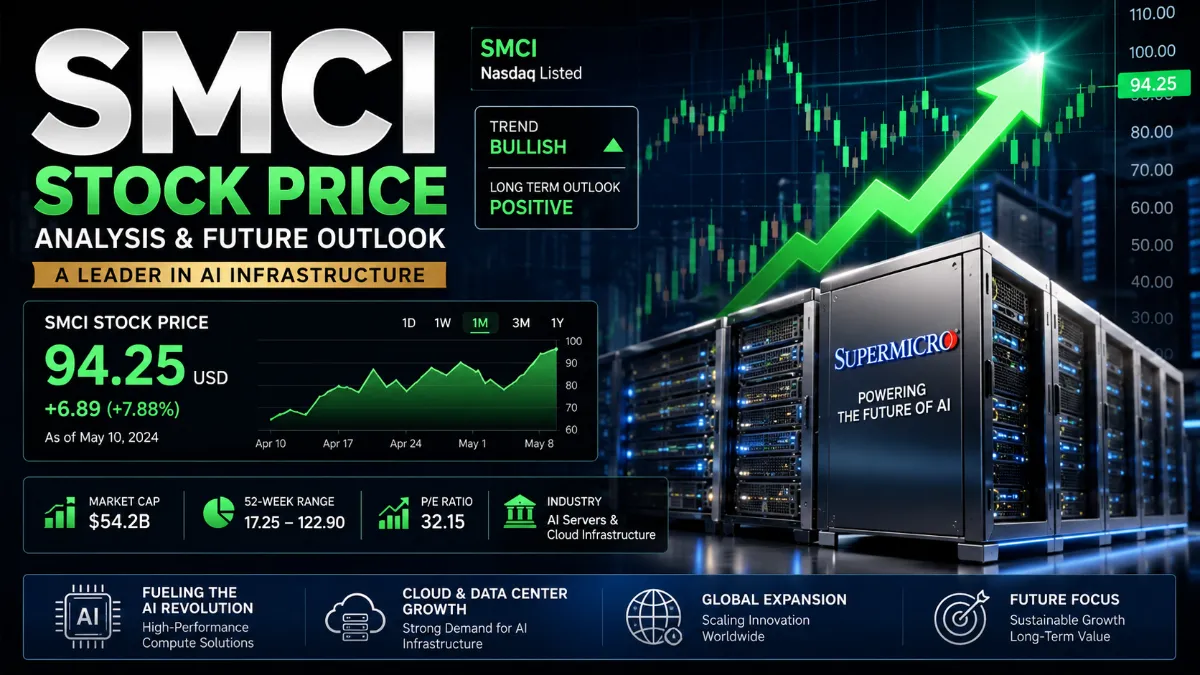
The SMCI stock price reflects investor sentiment around Super Micro Computer’s role in the fast-growing AI infrastructure market, where strong demand for servers is balanced by concerns over margins, cash flow, and financing. As AI data-center spending accelerates, SMCI has emerged as a key systems provider, but its stock remains highly volatile due to execution risks and financial pressures.
SMCI Stock Price Today
SMCI stock price closed at $31.13 on August 7, 2026, up 5.96% for the session. After-hours trading was near $31.38, and Super Micro Computer is scheduled to report fiscal fourth-quarter 2026 earnings after the market closes on August 11.
The near-term outlook is highly volatile. Investors are weighing unusually strong demand for AI servers against debt, cash-flow pressure, potential share dilution, and uncertainty about how profitably the company can fulfill its orders.
Market quotes may be delayed. Check a real-time brokerage quote before making a trading decision.
SMCI Stock Summary
Last closing price: $31.13
Daily price change: +5.96%
After-hours price: Approximately $31.38
Market capitalization: Approximately $19 billion
Trailing P/E ratio: Approximately 16–18x
52-week trading range: Approximately $19.48 to $58.78
Next earnings date: August 11, 2026
Consensus analyst rating: Hold
Options-implied weekly move: Approximately 14.6%
SMCI stock price definition: The SMCI stock price is the market value of one share of Super Micro Computer, a manufacturer of high-performance servers, storage systems, and rack-scale infrastructure used in AI data centers.
Quick Answers About SMCI
Is SMCI stock undervalued?
SMCI appears inexpensive on trailing earnings relative to some infrastructure peers. However, its valuation discount reflects meaningful risks: low gross margins, negative operating cash flow, rapidly rising debt, and the possibility of further share issuance.
Why is SMCI stock volatile?
The shares can move sharply when investors reassess AI-server demand, profit margins, working-capital needs, debt, financing plans, or earnings guidance.
What drives Super Micro Computer stock?
The most important drivers are quarterly revenue, gross margin, AI infrastructure demand, backlog conversion, operating cash flow, debt growth, and equity financing.
Is SMCI a good investment?
It may suit aggressive investors who can tolerate substantial volatility and execution risk. Investors seeking steady cash generation, lower leverage, and predictable margins may prefer to wait for clearer financial improvement.
What Does SMCI Do?
Super Micro Computer, also known as Supermicro, designs and builds servers, storage products, and complete rack-scale systems for AI data centers, cloud providers, and enterprise customers.
Its systems incorporate components from companies such as Nvidia, AMD, and Intel. Nvidia’s Blackwell platform, for example, is a generation of AI accelerators used to train and run large models; SMCI helps turn those chips, memory, networking, and storage into deployable server systems.
Supermicro is therefore an AI infrastructure supplier, not a chip designer. That position can produce rapid sales growth when data-center spending expands, but it also tends to generate lower margins than those earned by a differentiated semiconductor supplier.
Key takeaway: SMCI benefits from AI-server demand, but its lower-margin systems business makes execution and cash discipline especially important.
Why SMCI May Be Undervalued
SMCI trades at an earnings multiple that is below those of some large infrastructure peers. The bullish argument is straightforward: if AI-server demand remains strong, gross margins improve, and the company turns more of its revenue into cash, the market could assign the shares a higher valuation.
The potential positives include:
- Continued investment in AI data centers and accelerated computing.
- A large disclosed pipeline of AI-server orders.
- A comparatively low earnings multiple.
- Significant operating leverage if gross margins improve.
- A smaller market capitalization than larger AI infrastructure competitors.
The counterargument is equally important. A low P/E ratio does not automatically mean a stock is cheap when profits are volatile, cash flow is weak, and future financing may dilute existing shareholders.
Key takeaway: The valuation case depends less on headline revenue growth than on margin durability and cash conversion.
Why SMCI Trades at a Discount
SMCI’s discount reflects uncertainty about the economics of its rapid expansion.
In June 2026, the company announced up to $7 billion in equity and equity-linked financing. It said the capital would help fund component purchases needed to fulfill approximately $39 billion in recently received AI-server orders from more than 20 customers.
That announcement highlighted the central issue for investors: substantial orders can create major future revenue, but fulfilling them can require large up-front purchases of GPUs, memory, networking equipment, and other components.
A backlog is the value of customer orders not yet recognized as revenue. It is a demand indicator, not guaranteed profit or immediate cash flow. The timing of component supply, customer deployment, shipping, pricing, and collections can all affect how and when backlog becomes revenue.
Key takeaway: The market wants proof that SMCI can convert demand into profitable, cash-generating sales without excessive financing.
Three Catalysts to Watch
Gross-Margin Performance
Supermicro reported a 9.9% GAAP gross margin in fiscal third-quarter 2026, up from 6.3% in the prior quarter but still low for a business carrying substantial working-capital demands.
A sustained rise in gross margin would improve earnings quality and potentially support a higher valuation. A renewed decline would suggest that competition, component costs, or customer pricing are limiting the company’s profit potential.
Operating Cash Flow
Cash flow is the clearest measure of whether reported growth is financially self-sustaining. Supermicro reported $6.6 billion of cash used in operations during fiscal third-quarter 2026, largely reflecting working-capital requirements.
Improved operating cash flow would ease concerns over debt and dilution. Continued large cash outflows would suggest that rapid revenue growth is still consuming more capital than it produces.
AI-Server Order Conversion
The disclosed $39 billion order figure demonstrates strong demand, but investors should watch whether orders are converted into delivered systems, recognized revenue, acceptable margins, and customer payments.
Execution risks include component availability, customer deployment schedules, manufacturing capacity, pricing discipline, and changes in AI infrastructure spending.
Key takeaway: The August earnings report matters because it can clarify whether demand is translating into margins and cash flow—not merely higher sales.
SMCI Financial Snapshot
Fiscal 2023 revenue: $7.12 billion
Fiscal 2024 revenue: $14.99 billion
Fiscal 2025 revenue: $21.97 billion
Fiscal 2026 revenue outlook: Subject to earnings results and updated company guidance
Fiscal 2023 net income: $640 million
Fiscal 2024 net income: $1.15 billion
Fiscal 2025 net income: $1.05 billion
Fiscal 2026 third-quarter revenue: $10.2 billion
Fiscal 2026 third-quarter gross margin: 9.9%
Fiscal 2026 third-quarter operating cash flow: Negative $6.6 billion
Cash and cash equivalents as of March 31, 2026: $1.3 billion
Bank debt and convertible notes as of March 31, 2026: $8.8 billion
The financial picture is mixed. Revenue growth has been extraordinary, while operating cash flow and debt have created concern about the capital required to support that growth.
Key takeaway: Strong demand is clear; the unresolved question is whether SMCI can grow without sustained pressure on its balance sheet.
SMCI vs. Dell, HPE, and Nvidia
SMCI: A server and systems integrator with high AI exposure, relatively low gross margins, and heightened financing sensitivity.
Dell: A larger enterprise infrastructure company with broader customer relationships, more diversified operations, and comparatively steadier margins.
HPE: An enterprise technology and infrastructure provider with a larger services footprint and higher gross margins than SMCI.
Nvidia: The leading AI-accelerator supplier with highly differentiated products and substantially higher gross margins than systems integrators.
Nvidia captures more of the value from AI compute because it sells the core accelerator technology. SMCI operates further down the value chain, where growth may be faster in certain periods, but margins are thinner and working-capital needs are greater.
Key takeaway: SMCI offers more direct exposure to AI-server deployment, but it carries more balance-sheet and execution risk than the dominant chip supplier.
SMCI Investment Summary
Potential Strengths
- Strong demand for AI servers and data-center infrastructure.
- Approximately $39 billion in recently received AI-server orders disclosed in June 2026.
- A lower earnings multiple than some infrastructure peers.
- Potential for improved profitability if gross margins recover.
- Greater percentage-upside potential than larger, more mature AI companies.
Principal Risks
- Bank debt and convertible notes of approximately $8.8 billion as of March 31, 2026.
- Significant negative operating cash flow during fiscal third-quarter 2026.
- Low and potentially volatile gross margins.
- The possibility of shareholder dilution from future equity issuance.
- A large order pipeline that still must be manufactured, delivered, and collected.
Key takeaway: SMCI has meaningful AI-driven upside, but the risks are concentrated in financing, cash flow, and execution.
SMCI Outlook: Short Term vs. Long Term
Short-Term Outlook
The immediate focus is the August 11 earnings release. Investors will likely concentrate on gross margin, operating cash flow, debt, inventory, customer-payment timing, and fiscal 2027 commentary.
The options market’s implied move of approximately 14.6% indicates that investors expect a material post-earnings price swing. A margin improvement and a better cash-flow outlook could support the shares; disappointing margins or a need for further financing could increase selling pressure.
Long-Term Outlook
The longer-term case depends on continued AI data-center investment and Supermicro’s ability to execute profitably at scale.
For the bullish thesis to strengthen, the company needs to show sustained margin improvement, healthier operating cash flow, disciplined debt management, and backlog conversion that does not require repeated large equity raises.
Key takeaway: Earnings may drive the next move, but financial discipline will determine the long-term investment outcome.
Who Should Consider SMCI?
Aggressive investors: SMCI may be appropriate as a limited, high-risk AI infrastructure position for investors who can tolerate large price swings and closely follow earnings.
Long-term growth investors: The shares may be worth monitoring, but the case becomes stronger only if margins and cash generation improve across multiple quarters.
Conservative investors: SMCI is not an obvious fit at present. High leverage, negative operating cash flow, and dilution risk may outweigh the potential reward for lower-risk portfolios.
Short-term traders: Earnings volatility can create opportunities, but it can also produce large losses. Defined-risk strategies may be more appropriate than unhedged directional positions.
Read more: Explore More Latest Stock Market Updates, Financial Trends, and Investment Insights
SMCI Price Scenarios
Bull case: Gross margins improve materially, operating cash flow turns sustainably positive, debt growth slows, and the AI-server order pipeline converts efficiently.
Base case: Revenue continues to grow, but margins remain modest and working-capital needs limit valuation expansion.
Bear case: Gross margins weaken, cash burn persists, customer deployments are delayed, or the company needs additional debt or equity financing.
These are scenario frameworks, not price targets or guarantees. The primary variable is not whether AI demand exists, but whether SMCI can fulfill that demand at attractive economics.
Frequently Asked Questions
What is SMCI stock price today?
SMCI closed at $31.13 on August 7, 2026, a gain of 5.96% for the regular session. After-hours trading was near $31.38. The quoted price is a historical close and may not represent the current live market price. Investors should use a real-time brokerage quote before acting because SMCI can move sharply during extended trading and around earnings announcements.
When does Super Micro Computer report earnings?
Super Micro Computer is scheduled to report fiscal fourth-quarter 2026 earnings after the market closes on August 11, 2026. Investors will likely focus on revenue, gross margin, operating cash flow, balance-sheet changes, and management’s outlook for future AI-server orders. These metrics are particularly important because strong demand alone does not resolve concerns about profitability, working-capital requirements, or dilution.
Is SMCI stock undervalued?
SMCI can look undervalued when evaluated primarily on trailing earnings, especially compared with some infrastructure peers. However, the market is also pricing in low gross margins, sizable debt, negative operating cash flow, and financing risk. Whether the shares are genuinely undervalued depends on the company’s ability to convert AI-server demand into durable profits and internally generated cash rather than continued debt or equity funding.
Why did SMCI stock fall after its June 2026 financing announcement?
The company announced up to $7 billion in equity and equity-linked financing to help purchase components for approximately $39 billion in recently received AI-server orders. Investors reacted to the potential dilution and the fact that fulfilling fast-growing demand requires substantial capital. The financing demonstrated powerful order demand, but it also raised questions about the company’s cash needs and the value retained by existing shareholders.
What are SMCI’s biggest risks?
The most important risks are weak or volatile gross margins, large working-capital requirements, negative operating cash flow, debt growth, and the need for potential future share issuance. A large backlog also carries execution risk: component availability, customer readiness, delivery schedules, and pricing can all affect when orders become revenue and how profitable those sales are. Investors should weigh these risks against the company’s AI infrastructure opportunity.
What does SMCI’s backlog mean for investors?
A backlog is a pool of orders that customers have placed, but that have not yet been recognized as revenue. It can signal strong future demand, but it is not equivalent to revenue, profit, or cash. For SMCI, the key question is how efficiently the company can source components, build systems, ship them, and collect payment while maintaining acceptable margins. Backlog quality and conversion speed matter as much as its headline value.
Is SMCI a good long-term investment?
SMCI may appeal to investors who want higher-risk exposure to AI data-center expansion and can hold through significant volatility. A stronger long-term case would require consistent gross-margin improvement, positive operating cash flow, and reduced dependence on new financing. Investors who prioritize financial stability and predictable margins may prefer to watch for evidence that these improvements are durable before considering a position.
Is SMCI better than Nvidia?
The companies occupy different positions in the AI ecosystem. Nvidia supplies specialized AI accelerators and earns much higher margins, while SMCI builds server systems that integrate components from suppliers such as Nvidia. SMCI may offer larger percentage upside if execution improves because of its smaller scale, but it also has lower margins and greater financing risk. They serve different roles rather than being direct substitutes.
What should investors watch in SMCI’s next earnings report?
The most important items are gross margin, operating cash flow, debt, inventory, receivables, and management’s discussion of customer orders and delivery timing. Investors should also assess whether revenue growth is translating into improving profitability and cash generation. A revenue beat without better margins or cash flow may not be enough to change the market’s concern about the company’s financing requirements.
Can SMCI recover to its previous all-time high?
A return to prior highs would likely require more than continued revenue growth. Investors would need confidence that AI-server demand can convert into sustained high-quality earnings, lower cash burn, controlled debt, and limited dilution. The company would also need to demonstrate that its gross-margin improvement is durable. Until those factors are established, a full recovery remains possible but uncertain rather than a base-case assumption.
Final Verdict: Buy, Hold, or Avoid?
SMCI is a speculative Buy for aggressive investors, a Hold for existing investors awaiting financial confirmation, and an Avoid for conservative investors.
The shares may be undervalued if Supermicro can turn its AI-server demand into higher margins and sustainable cash generation. But negative operating cash flow, approximately $8.8 billion of debt and convertible notes, low margins, and dilution risk justify caution.
Final one-line verdict: Consider SMCI only if you can accept high volatility and meaningful downside; otherwise, wait for sustained improvement in margins, cash flow, and financing discipline.