
Juniper Bonsai Care: Complete Guide to Healthy Growth, Styling, and Home Display
9 min read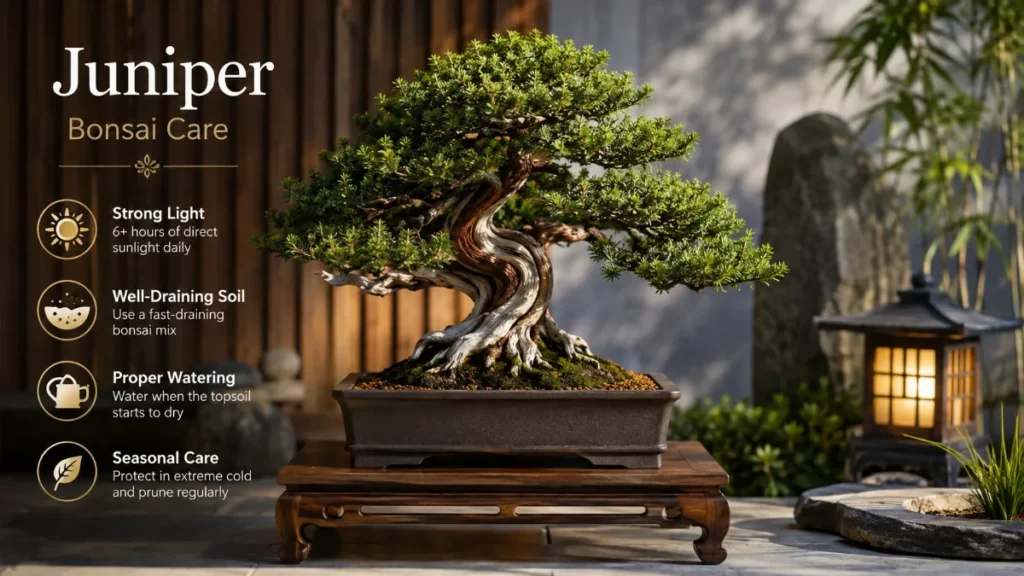
Juniper bonsai care becomes much easier once you understand one foundational rule: a juniper bonsai is an outdoor tree, not a conventional houseplant. It needs strong natural light, good airflow, controlled moisture, and seasonal conditions to remain healthy. You can bring it indoors briefly for a special display, but a heated room should not become its permanent growing environment.
That single distinction affects almost every decision you make-from where the tree sits to how often you water, when you prune, how you protect it in winter, and how you incorporate it into home decor.
The goal is not to follow a rigid calendar. It is to understand what the tree is telling you and adjust its care to the environment.
The Essentials of Juniper Bonsai Care
A healthy juniper needs five things working together:
- Strong outdoor light
- A well-draining root environment
- Watering based on actual soil moisture
- Appropriate nutrition during active growth
- Seasonal conditions and protection from genuinely severe weather
Junipers are not one identical plant. The genus contains many species, and bonsai commonly include different types with either scale-like or needle-like foliage. Their growth habits and exact tolerances can vary, so species and local climate should influence detailed decisions.
The most useful priority order is:
Location → light → water → drainage → nutrition → pruning → styling
That order prevents a common beginner mistake: spending more time trying to perfect the appearance than fixing the growing conditions.
Can a Juniper Bonsai Live Indoors?
No, not permanently.
Junipers are outdoor bonsai and require strong natural light and seasonal conditions. Bonsai Empire specifically recommends keeping junipers outside year-round and using cold protection when temperatures become severe.
A bright window may look sunny to you, but indoor light is generally much weaker than direct outdoor sunlight. A heated home also removes the natural temperature cycle that a temperate conifer expects.
When Indoor Display Is Safe
A short indoor visit can work for:
- A dinner party
- A photograph
- A celebration
- Seasonal decoration
- A brief presentation
Place the tree in the brightest practical location and keep it away from fireplaces, radiators, heating vents, and strong air-conditioning drafts.
Think of the living room as a temporary exhibition space, not the tree’s permanent habitat.
If you specifically want a bonsai that can live indoors, tropical and subtropical species are generally more appropriate than juniper.
How Much Sunlight Does a Juniper Bonsai Need?
Junipers generally perform best in full sun or another very bright outdoor position. Bonsai guidance commonly recommends several hours of direct sunlight, but an exact universal number is less useful than considering the species, climate, season, and intensity of the exposure.
Good positions include:
- An open patio
- A sunny balcony
- A bright terrace
- An outdoor plant stand
- An exposed garden bench
- A porch that still receives substantial direct light
Morning sun can be particularly useful in very hot climates because it provides strong light before the harshest afternoon heat. However, do not automatically shade a juniper from afternoon sun. Judge the tree and its local microclimate.
What About Extreme Summer Heat?
A shallow bonsai container can heat and dry faster than garden soil.
During extreme heat, temporary protection from the harshest afternoon exposure may be appropriate if the tree is showing heat stress. Good airflow and strong light should remain priorities.
The objective is not “maximum sun at any cost.” It is strong light without unnecessary environmental stress.
Watering: Use the Soil, Not a Calendar
One of the most important rules of juniper bonsai care is to stop thinking in terms of “water every two days.”
Watering frequency changes with:
- Temperature
- Sun exposure
- Wind
- Pot size
- Soil composition
- Rainfall
- Season
- Tree size
Instead, inspect the substrate. When it has begun to dry slightly, water thoroughly so the root zone is properly moistened and excess water escapes through the drainage holes. Juniper roots dislike continuously wet conditions.
What Overwatering Really Means
Overwatering does not simply mean giving a tree too much water in one session.
The more serious problem is repeatedly keeping the root zone saturated.
When water occupies the pore spaces for too long, roots have less access to oxygen, and prolonged excess moisture can contribute to root disease. Junipers are among the woody ornamentals susceptible to root problems associated with excessive soil moisture.
At the other extreme, a small bonsai container can dry quickly during hot, windy weather.
Use this simple cycle:
Check → water thoroughly → drain completely → check again before watering.
Soil and Drainage
Junipers need a substrate that drains efficiently while retaining enough moisture for the local growing conditions.
Common bonsai components include:
- Akadama
- Pumice
- Lava rock
- Other purpose-made mineral or bonsai substrates
There is no single mandatory recipe. A quality commercial bonsai mix can also work.
The important question is whether the root environment stays appropriately moist without remaining saturated.
Avoid Heavy, Water-Retentive Soil
Ordinary garden soil can behave poorly in a shallow bonsai container. Dense moisture-retaining mixes may restrict drainage and air exchange.
If water sits around the roots for prolonged periods, changing the watering schedule alone may not solve the problem. The substrate and drainage system may need attention.
Fertilizing a Juniper Bonsai
Fertilizer supports healthy growth, but it cannot repair poor light, damaged roots, or bad drainage.
Bonsai Empire recommends regular feeding during the growing season, with organic fertilizer pellets or liquid fertilizer used according to the product directions.
A sensible approach is to:
- Feed primarily during active growth.
- Follow the product label.
- Avoid excessive doses.
- Do not use fertilizer as an emergency treatment for a declining tree.
- Be cautious around major root problems or significant stress.
Strong growth comes from the entire system: light, roots, water, nutrition, and seasonal conditions.
Pruning and Wiring
Junipers are popular bonsai subjects because they tolerate training and can develop dramatic branch structures.
Common styles include:
- Informal upright
- Cascade
- Windswept
- Literati-inspired forms
- Deadwood-focused designs
But junipers should not be treated like hedge plants.
They do not reliably produce new growth from completely bare old sections. If a branch is important to the design, retain viable foliage on it. Bonsai Empire specifically warns against removing all growing tips and recommends keeping foliage on branches intended to remain alive.
Pruning for Better Foliage Pads
Remove:
- Clearly dead branches
- Damaged material
- Unwanted shoots
- Crossing growth
- Excessively congested foliage
Avoid creating perfectly solid “balls” of greenery. Dense pads can shade their own interiors, reducing light and airflow.
Opening the foliage structure can therefore improve both appearance and long-term health.
Wiring
Wiring should gradually position branches rather than force them into place.
When wiring:
- Work with the branch’s natural flexibility.
- Protect bark when major bending is required.
- Be especially cautious around deadwood.
- Inspect wired areas regularly.
- Remove wire before it becomes embedded.
Junipers can tolerate substantial shaping, but aggressive bending still needs judgment. Deadwood can be brittle even when the living portion of the branch is flexible.
Repotting Without Unnecessary Stress
Repotting should solve a root or substrate problem, not become an automatic annual ritual.
Common reasons to repot include:
- Degraded substrate
- Poor drainage
- Significant root congestion
- A container that no longer suits the tree
- Planned development of the root system
Bonsai Empire gives approximately two years as a general juniper repotting interval, while noting that older trees may go longer. It also advises against overly aggressive root pruning.
If the foliage suddenly turns brown, do not assume repotting is the answer. Diagnose the environment first.
Seasonal Care Calendar
| Season | Main focus | What to monitor |
| Spring | Growth resumes | Water demand, new shoots, pests, feeding |
| Summer | Heat and moisture | Drying speed, wind, container heat |
| Autumn | Seasonal transition | Changing moisture needs and winter preparation |
| Winter | Dormancy and protection | Severe cold, frozen root zone, drying wind |
Winter Protection
Junipers need seasonal cold, but their roots are more exposed to extreme temperatures in a shallow bonsai container.
Bonsai Empire recommends additional protection once temperatures fall below approximately 15°F (-10°C), such as placing the tree in a cold frame. This is a practical guideline, not a universal survival threshold; species, acclimation, container size, wind, and local climate all matter.
Keep the tree cool rather than moving it into a heated living room for the entire winter.
Some junipers also develop purplish-brown foliage during frosty periods as part of their cold response and can return to green when conditions warm.
Common Juniper Problems
Brown foliage is a symptom, not a diagnosis.
Possible causes include:
- Poor light
- Water stress
- Root problems
- Winter injury
- Scale
- Spider mites
- Twig blights
- Rust diseases
- Other environmental stresses
University of Minnesota Extension separates juniper problems according to symptom patterns rather than treating all browning as the same issue.
Juniper Scale
Juniper scale can appear as small white, spot-like coverings on the foliage. Heavy infestations can cause dull foliage, yellowing, branch dieback, and eventually serious decline.
Inspect closely before treating.
Root Rot
Persistent waterlogging is a major warning sign. Extension guidance associates juniper root rot with heavy, waterlogged soil and dark, soft, mushy roots.
Brown needles alone do not prove root rot.
Rust
Cedar-apple and related rust diseases can produce distinctive woody galls on juniper twigs. In wet spring weather, orange gelatinous structures may emerge from those galls.
That is a much more useful diagnostic clue than simply assuming orange or brown foliage means rust.
A Simple Weekly Care Check
Good juniper bonsai care is largely about observation.
Once a week, check:
Light: Is the tree still receiving appropriate outdoor exposure?
Soil: Has the substrate begun to dry?
Drainage: Does water escape freely?
Foliage: Is there discoloration, webbing, scale, or unusual spotting?
Branches: Are important branches still alive and flexible?
Weather: Have heat, wind, frost, or prolonged rain changed the tree’s needs?
This habit is more reliable than following a rigid calendar.
How to Make a Healthy Juniper Part of Home Decor
Once the tree is healthy, styling can become part of the home’s visual language.
A juniper can work beautifully on:
- A minimalist patio
- A balcony table
- A traditional bonsai stand
- A stone terrace
- A sheltered outdoor entryway
- A garden seating area
Choose the Pot Around the Tree
An informal upright tree may suit an oval or rectangular container. A cascade generally benefits from a container that supports its downward movement. A windswept tree can look stronger with a restrained pot that allows its directional structure to dominate.
Traditional proportion rules are useful starting points, but they should not override the actual tree.
Read more: Juniper Bonsai Care: Complete Guide to Healthy Growth, Styling, and Home Display
Choose a Stand Around the Viewing Angle
There is no universal “correct” stand height.
Consider:
- Tree height
- Viewing distance
- Trunk movement
- Canopy width
- Surrounding furniture
- Whether the tree is upright or cascading
A cascade usually benefits from elevation because the descending structure needs open space below it.
Frequently Asked Questions
Can a juniper bonsai live indoors permanently?
No. Junipers are outdoor bonsai that need strong natural light and seasonal conditions. Indoor display should be temporary.
How often should I water a juniper bonsai?
There is no universal schedule. Check the substrate and water thoroughly when it has begun to dry slightly. Frequency depends on weather, soil, pot size, wind, and season.
How much sunlight does a juniper bonsai need?
Junipers generally perform best in full sun or another very bright outdoor location. Exact exposure depends on species and climate.
What soil is best for a juniper bonsai?
Use a well-draining bonsai substrate. Akadama, pumice, and lava rock are common components, but a quality commercial bonsai mix can also be suitable.
Can I bring my juniper bonsai indoors for decoration?
Yes, briefly. Keep the indoor visit short, use the brightest practical location, and return the tree outdoors afterward.
When should I prune a juniper bonsai?
Pruning should depend on the type of work and the tree’s growth. Avoid removing all healthy foliage from branches you want to keep.
How often should I repot a juniper bonsai?
A commonly cited specialist interval is about two years, although older trees may need longer. Root condition and substrate quality are more important than a rigid calendar.
Why is my juniper bonsai turning brown?
Possible causes include insufficient light, watering stress, root problems, pests, disease, and winter injury. Some junipers also change color naturally during frost.
Does a juniper bonsai need winter protection?
It may need additional protection during severe cold because the shallow container exposes the roots. A cold frame or sheltered outdoor position can help.
Can I use a decorative outer pot?
Yes, provided it does not block drainage or allow water to remain trapped around the bonsai container.
Final Takeaway
The foundation of juniper bonsai care is simple: keep the tree outdoors, provide strong light, monitor moisture, maintain excellent drainage, feed during active growth, preserve viable foliage, and adapt protection to the season.
The decorative side should follow those biological requirements.
A healthy juniper does not need excessive accessories or constant intervention. Its trunk, foliage, pot, stand, and surrounding negative space can create a sophisticated display on their own.
Care for the tree first, style it second, and use indoor placement only as a brief change of scenery.