Hero Forge: Complete Guide to Custom Miniatures, STL Files, and 3D Printing
12 min read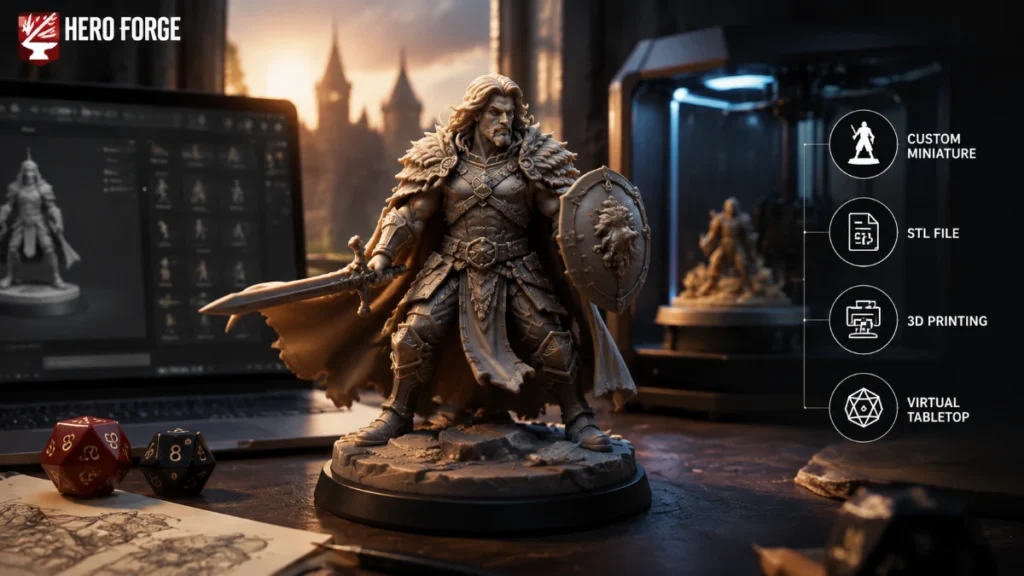
Hero Forge is a browser-based character creator built for people who want a tabletop miniature that looks like their character rather than the closest pre-made figure they can find. You can design a character in 3D, customize its appearance and pose, preview colors, and then choose between a manufactured physical miniature, an STL file for home 3D printing, or a digital 3D miniature for supported virtual tabletops.
The important part is understanding that these outputs serve different purposes. Buying a physical miniature does not automatically give you the STL, and an STL is not the same product as a color-textured virtual tabletop model. This guide explains the character creator, physical materials, digital formats, subscriptions, 3D-printing requirements, VTT compatibility, licensing limits, and the choices that matter before you spend money.
What Is Hero Forge?
Hero Forge is a custom miniature and character-design platform operated by Sky Castle Studios. Its browser-based editor allows users to construct characters from interchangeable body features, clothing, armor, equipment, poses, colors, facial options, bases, and other components before deciding whether to purchase the resulting design in physical or digital form.
The basic creator is free. Hero Forge lists its Basic tier at $0 and includes full-color design tools, weekly content releases, screenshot exports, and direct links to designs. More advanced creation features are available through its optional Pro subscriptions.
Although the tool is closely associated with Dungeons & Dragons, it is not limited to Hero Forge D&D characters. Its roughly 30mm tabletop scale and common base sizes make its miniatures suitable for many tabletop role-playing and tactical games. The creator also supports a wide range of fantasy, science-fiction, modern, supernatural, and other character concepts.
How the Hero Forge Character Creator Works
The Hero Forge character creator works more like a modular 3D modeling system than a conventional avatar form. Instead of selecting a finished character and changing a few colors, you assemble a miniature from editable components.
You can adjust characteristics such as body features, faces, hair, clothing, armor, equipment, weapons, accessories, expressions, colors, positioning, and bases. Characters can also be posed rather than being restricted to a single neutral stance.
That flexibility is important because a miniature’s pose affects more than appearance. Weapon placement, limbs, accessories, tails, wings, and other projecting details can influence how large or delicate the resulting physical model becomes.
The platform also continues to receive new creator content. Its Basic subscription comparison specifically lists new content every week, while Pro subscribers receive additional creator functionality and beta access.
Face Customization, Posing, and Color
Facial customization gives users finer control over expressions and facial construction than the older preset-driven approach associated with early versions of the platform.
Posing then determines how the character occupies the miniature’s physical space. A fighter can hold a weapon differently, a spellcaster can be positioned mid-cast, and equipment can be arranged to support a specific character concept rather than simply hanging from a default pose.
Color tools are useful even when you intend to paint the miniature yourself because they provide a visual reference for clothing, armor, skin, hair, magical effects, and other materials. For Color Plastic products, however, the color preview has an additional practical role because the physical model itself is produced in color.
Hero Forge notes that its on-screen character creator renders more detail and dynamic lighting than a 30mm physical miniature can reproduce. Reflective or metallic-looking effects in the creator may therefore appear as non-metallic printed textures on physical color miniatures.
Hero Forge Miniatures, STL Files, and 3D Digital Models Explained
The easiest way to avoid buying the wrong format is to choose according to where the character will actually be used.
| Product | What You Receive | Best For | Current Base Price |
| Standard Plastic miniature | Manufactured physical miniature | Painting and tabletop play | From $19.99 |
| STL download | Printable 3D mesh | Home 3D printing | $7.99 |
| 3D Digital miniature | Colored digital 3D model | Supported virtual tabletops | $7.99 |
| Color Plastic miniature | Full-color physical miniature | Table-ready physical play | From $39.99 |
| Bronze miniature | Cast physical collectible | Keepsakes and display | From $99.99 |
Standard Plastic, STL, 3D Digital, Color Plastic, and Bronze pricing above reflects Hero Forge’s published product information at the time of this update. Larger or more complex physical models can cost more under the platform’s size-based pricing system.
Most importantly, these products are purchased separately. Hero Forge’s support documentation explicitly states that buying a physical mini does not include a free digital model.
Physical Hero Forge Custom Miniatures
For players who want a miniature delivered rather than printed at home, the platform offers several physical formats with different priorities.
Standard Plastic starts at $19.99. It is printed using stereolithography, supplied in a matte gray primer, and intended in part for hobbyists who want to paint their miniature themselves. The company describes the material as approximately 30mm scale and offers several base sizes, including ½-inch, 1-inch, 1-by-2-inch, and 2-by-2-inch options depending on the design.
Premium Plastic starts at $29.99 and uses a higher-detail DLP printing process. Hero Forge lists a 35-micron layer thickness and positions the material primarily toward painters and players who want greater physical detail.
Color Plastic starts at $39.99 and prints color directly into the miniature, eliminating the need to hand-paint the model before play. Its printed appearance can differ from the dynamically lit creator preview, particularly for reflective effects and extremely fine details.
Bronze starts at $99.99. Rather than functioning mainly as a budget gaming piece, it is positioned as a durable keepsake or premium display miniature. The product is manufactured through a lost-wax casting process and is offered in polished and antiqued finishes.
The product range has also expanded beyond the older Standard/Premium/Color lineup. Hero Forge now advertises Ultra High-Definition Color Plastic for designs where decals and very fine surface details are especially important. The company cautions that the higher-detail material is more fragile and is particularly suited to display-oriented designs.
How Refined XL Pricing Affects Physical Minis
Physical miniature prices are not necessarily fixed at the starting amount.
Hero Forge’s Refined XL Pricing system calculates increases more gradually according to a model’s overall volume, scale, and complexity rather than relying only on the older large jumps between standard, XL, and XXL categories. As a result, two designs ordered in the same material can have different final prices.
For comparison-shopping, the useful rule is simple: treat published figures such as $19.99 or $39.99 as starting prices, then check the actual Buy menu after completing your character.
Hero Forge 3D Printing: What You Get With an STL
For users with access to a 3D printer, a Hero Forge STL is the product designed specifically for making a physical copy at home.
A custom STL currently costs $7.99 for a single-character design. Files are distributed as zipped .stl models and are typically around 5–10 MB. Hero Forge states that the meshes can contain up to approximately 100,000 triangles and are not rigged for animation.
Color information from the character creator is not included in the STL. An STL contains the geometry needed for printing; it is not a textured digital tabletop model.
The files also do not come with print supports. You therefore need to prepare the model using appropriate slicing software and create whatever supports, orientation, exposure settings, layer settings, or other printer-specific preparation your machine requires.
Resin vs. Filament Printing
Hero Forge states that its STL files can be used with both resin and filament printers, but it also warns that miniature-scale features can challenge some home printers. Very thin projecting parts and other fine elements may not reproduce as cleanly as they appear in the high-resolution browser preview.
For users primarily interested in highly detailed tabletop miniatures, this means printer capability matters as much as the purchased mesh.
A sensible first step is to print one of the free sample STL models Hero Forge provides before buying a custom file. That test can reveal whether your printer, slicer settings, supports, and preferred material are capable of reproducing the level of detail you expect.
Download Your STL and Back It Up
Do not treat the account’s download page as permanent archival storage.
Hero Forge says purchased STL models are guaranteed to remain available through the Digital Downloads page for six months after purchase. Once your file is ready, downloading it and maintaining your own backup is therefore the safer approach.
3D Digital Miniatures for Virtual Tabletops
A 3D Digital miniature is a different product from an STL. It retains the colors, effects, pose, and other visual information needed for supported virtual tabletop use and currently costs $7.99 for a single-character design.
It is not intended for home 3D printing. If your goal is to manufacture a physical miniature yourself, buy the STL instead.
Hero Forge uses an Access Key system to connect purchased 3D Digital miniatures with compatible tabletop services. Once an account is connected, completed digital purchases can automatically become available inside the supported platform.
The current official product page lists TaleSpire, Harpy, Dungeon Alchemist, MirrorScape, Battle Map Studio, Foundry VTT, Scene Grinder, RPG Stories, and Tabletop Simulator, with Tabletop Simulator using the Unity Asset Bundle format.
Compatibility can change as third-party VTT software evolves, so checking the current supported-platform documentation before buying specifically for one virtual tabletop is worthwhile.
Hero Forge Pro: Is the Subscription Necessary?
No subscription is required to design a normal character or buy a one-off miniature.
The free Basic tier includes the core color design tools, weekly content releases, screenshots, and links to designs. Pro becomes useful when you want advanced editing and organizational tools rather than simply a single custom miniature.
Standard Pro currently costs $5.99 for a one-month term, $4.99 per month on a three-month term, or $3.99 per month on a 12-month term. It adds features including Kitbashing, Decal Kitbashing, Token Maker, HD character portraits, Scene Maker, folders, saved paints, importing components from saved characters, Collaborator Collections access, and beta access to upcoming features and content.
Kitbashing is particularly significant for advanced creators because it lets subscribers place and manipulate items more freely instead of being limited to their conventional attachment points.
Pro+ Digital Download includes the Pro feature set plus five digital credits per month and monthly featured pre-made digital packs. Hero Forge currently prices it at $19.99 for a one-month term, $16.99 per month for three months, or $14.99 per month for 12 months.
Each digital credit can be applied to an STL or 3D Digital miniature, and the account can hold up to 120 credits. Hero Forge’s current FAQ also says digital credits do not expire.
For someone buying one miniature, Pro is usually unnecessary. For frequent designers, kitbashers, home printers, or VTT users acquiring multiple digital characters, the subscription benefits are much more relevant.
What Are Collaborator Collections?
Collaborator Collections are licensed character-part collections that sit alongside Hero Forge’s normal recurring content.
The first major example was its Daggerheart partnership with Darrington Press, covering the Simiah, Ribbet, and Fungril ancestries. The initial paid-collection approach generated enough negative community feedback that Hero Forge publicly acknowledged the concern and changed course.
Under the current arrangement, Daggerheart Collaborator Collections are included for Pro and Pro+ subscribers. Non-subscribers can purchase the collections separately. Hero Forge also states that eligible subscribers who had already purchased affected collections would be reimbursed through account or digital credit depending on how the purchase was made.
That distinction is useful because not every asset visible within the broader creator necessarily follows the same access model.
Who Owns a Character Made With Hero Forge?
This is one area where the platform’s terms deserve careful reading.
According to Sky Castle Studios’ Terms of Service, you retain ownership of the general and abstract elements of an original character that existed before you used the site-for example, its name and basic original character concept. However, the specific visual depiction and 3D model created through the platform are treated as property of Sky Castle Studios.
Downloaded 3D models are licensed for personal, noncommercial use. The terms prohibit reselling or redistributing those files and prohibit selling physical items printed from them for commercial purposes.
There is an important distinction for a physical miniature legitimately purchased from the company: Hero Forge’s support documentation states that the owner may resell that individual tangible miniature under first-sale principles. That does not grant rights to reproduce the underlying design or sell additional copies.
For a home campaign, personal collection, gift, or private 3D-printing project, these rules are usually straightforward. For commercial games, merchandise, Kickstarter products, or repeated miniature sales, they become a significant limitation.
Read more: Hero Forge: Complete Guide to Custom Miniatures, STL Files, and 3D Printing
Which Hero Forge Option Should You Choose?
The right purchase depends primarily on how you intend to use the character.
Choose a physical miniature if you want the simplest route from character design to an object you can put directly on the table.
Choose Standard or Premium Plastic if you enjoy painting and want control over the final finish.
Choose Color Plastic if you want a physical character with color already printed.
Choose an STL if you own or have access to a suitable 3D printer and are comfortable slicing, supporting, printing, cleaning, and potentially painting the model yourself.
Choose a 3D Digital miniature if the character will primarily appear inside a compatible virtual tabletop.
Choose Pro if your priority is deeper character creation, kitbashing, saved assets, tokens, scenes, portraits, or organizational features.
Choose Pro+ if those advanced tools are useful, and you also expect to acquire multiple STL or VTT models through digital credits.
The main mistake to avoid is buying according to the word “digital” rather than the actual use case. STL and 3D Digital products are both digital purchases, but one is intended to become a printed physical object while the other is designed for virtual tabletop play.
Frequently Asked Questions
Is Hero Forge free?
Yes. The Basic creator tier is free and includes the core character-design tools. Payment is required when purchasing physical products, digital files, licensed content sold separately, or an optional Pro subscription.
How much does a Hero Forge miniature cost?
Standard Plastic currently starts at $19.99, Premium Plastic at $29.99, and Color Plastic at $39.99. Physical prices can increase according to the model’s size and complexity.
How much is a Hero Forge STL?
A single-character custom STL currently costs $7.99. The resulting file is intended for personal home 3D printing.
Does an STL include the character’s colors?
No. The STL contains printable geometry but does not contain the color information applied in the online character creator.
Do I need a 3D printer?
Only if you buy an STL and intend to print it yourself. Physical miniatures are manufactured for you, while 3D Digital miniatures are designed for compatible virtual tabletop software.
Are supports included with Hero Forge STL files?
No. The company’s digital-model documentation states that STL files do not come with supports, so print preparation must be handled in your slicing workflow.
How long are purchased STL files available for download?
Hero Forge guarantees availability on the Digital Downloads page for six months from purchase. Downloading and backing up purchased files is therefore recommended.
What scale are the physical miniatures?
Most are approximately 30mm, or roughly 1:60 scale, with base options designed around common tabletop gaming dimensions.
Do I need Hero Forge Pro for Kitbashing?
Yes. Kitbashing is a Pro/Pro+ feature. The normal Basic creator remains free, while advanced free-placement and manipulation of objects through Kitbashing requires a subscription.
Can I commercially sell models I print from purchased STL files?
No, under the standard license. The Terms of Service permit personal, noncommercial use of downloadable 3D models and prohibit commercial sale of physical products printed from those models.
Final Takeaway
Hero Forge is most useful because it connects one character design system to several different tabletop workflows. A player can order a ready-made physical miniature, a painter can choose an unpainted plastic version, a home-printing hobbyist can buy an STL, and an online group can purchase a textured 3D Digital model for a supported VTT.
You do not need a subscription for the core experience. The key decision is simply choosing the correct output for your intended use and understanding that physical minis, STL files, and VTT models are separate products.
For occasional players, designing for free and making a single purchase is usually the most straightforward route. For frequent creators, kitbashers, home printers, or digital-tabletop users, Pro and Pro+ can make more sense because their value comes from repeated use rather than access to the basic character creator.