Ultrahuman Ring: Complete 2026 Guide to AIR, PRO, Features, Accuracy, Price and Value
12 min read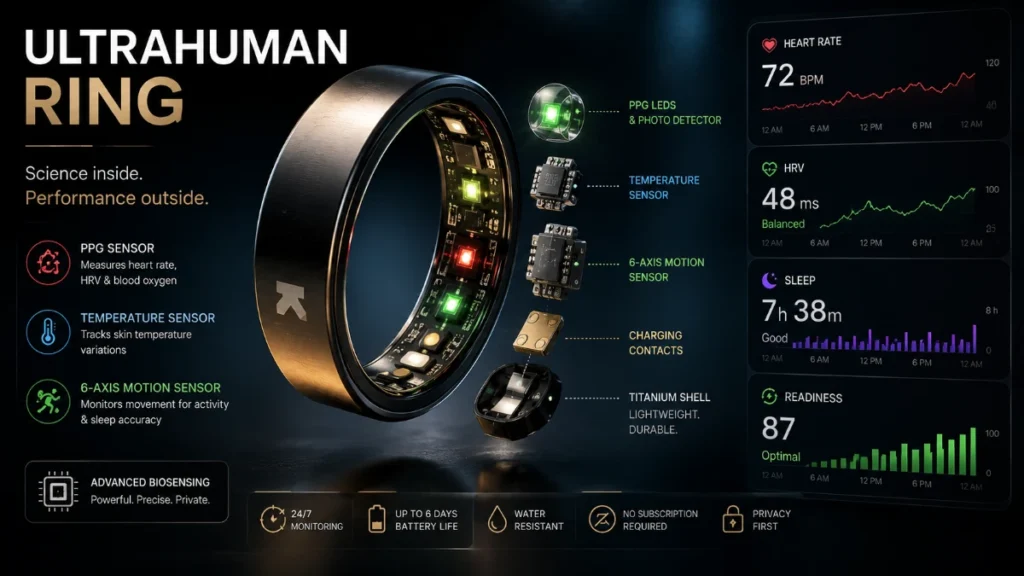
The Ultrahuman Ring is a screen-free wearable designed to track health and recovery information while you sleep, exercise and go about your normal day. Instead of putting notifications, apps and a display on your finger, it uses sensors to collect physiological and movement data and then presents that information through the Ultrahuman app.
The lineup has also changed significantly in 2026. Ring AIR remains the lighter, lower-priced option, while Ring PRO is now the flagship model with a substantially longer battery, more on-device storage, a redesigned sensing system and a dedicated charging case. Ultrahuman’s current comparison lists AIR at $349 and PRO at $479 in the U.S., with both models available in sizes 5-14.
That does not automatically make PRO the better purchase. AIR is considerably lighter and still provides the core sleep, recovery and wellness experience. PRO’s advantages are concentrated around battery life, storage, charging convenience and newer hardware.
There is another important part of the story: recent independent testing has found that the hardware is impressive but that activity and step tracking can be inconsistent, while the app can present more information than some users actually need.
So this guide looks beyond the specification sheet. It explains what the current models do, what the measurements are useful for, where the limitations are, how AIR compares with PRO and Oura, and which type of buyer gets the most value.
What Is the Ultrahuman Ring?
The simplest description is a passive health and recovery tracker worn on your finger.
There is no display, GPS navigation screen or notification panel. Most of the time, you simply wear it. The sensors collect information and the phone app turns that information into trends, scores and recommendations.
Ring AIR uses photoplethysmography (PPG), temperature sensing and six-axis motion sensors. Ultrahuman lists measurements and features covering heart rate, HRV, temperature, oxygen saturation, sleep, movement and recovery-related insights. AIR is 8.1 mm wide, varies from 2.45-2.8 mm in thickness depending on size, and weighs roughly 2.4-3.6 grams.
Ring PRO takes the same general concept further with a titanium-focused construction, redesigned heart-rate sensing, a dual-core processor with on-chip machine learning and substantially more storage. Ultrahuman announced PRO on February 27, 2026.
The important distinction is that the ring isn’t intended to replace every function of a smartwatch.
It is primarily about continuous background information.
Ring AIR vs Ring PRO: The Difference That Actually Matters
The most useful way to think about the two models is simple:
AIR prioritizes value and low weight. PRO prioritizes battery life and convenience.
Ring AIR
AIR remains the sensible starting point for buyers who want the core Ultrahuman experience without paying for the newest hardware.
Ultrahuman lists AIR at $349 in the U.S. and ₹28,499 in India. It weighs about 2.4 grams in the official comparison and offers four to six days of battery life.
For someone primarily interested in:
- sleep tracking
- recovery trends
- HRV
- heart rate
- temperature
- passive wellness monitoring
AIR covers the essential use case.
Its biggest disadvantage is not what it can measure. It is what happens when the battery needs charging every few days.
Ring PRO
PRO is the current flagship.
Its headline specification is battery life: up to 15 days, with Ultrahuman specifying approximately 12 days in Turbo Mode and more than 15 days in Chill Mode. It can also store up to 250 days of health data on the ring, while the charging case can provide up to 45 days of battery capacity under the company’s stated conditions.
The PRO also introduces:
- redesigned PPG sensing
- dual-core processing
- on-chip machine learning
- a titanium unibody design
- ProRelease safety technology
- UltraSnap magnetic charging
- Find My Case functionality
- substantially greater data storage
Those are meaningful hardware improvements.
But they don’t automatically mean that every AIR owner needs to upgrade.
AIR vs PRO at a glance
| Feature | Ring AIR | Ring PRO |
| U.S. listed price | $349 | $479 |
| India listed price | ₹28,499 | ₹44,999 |
| Weight | 2.4 g | 3.3-4.8 g |
| Thickness | 2.4 mm | 2.65 mm |
| Battery | 4-6 days | Up to 15 days |
| Turbo Mode | – | About 12 days |
| On-device storage | About 4 days | Up to 250 days |
| Charging | Wireless pad | PRO Charging Case |
| Case battery | – | Up to 45 days |
| Processor | Single-core | Dual-core + on-chip ML |
| Sizes | 5-14 | 5-14 |
| Water resistance | 100 m / 328 ft | 100 m / 328 ft |
Specifications are based on Ultrahuman’s current comparison and product listings. Actual battery performance varies with settings and use.
The extra $130 in the U.S. or ₹16,500 in India therefore buys hardware convenience, not a completely different category of health tracking.
What Does the Ring Track?
The platform is much broader than a step counter.
Sleep Tracking
Sleep is one of the most natural use cases for a screen-free ring.
The device can be worn overnight without the distractions of a watch display. The app uses collected data to present sleep duration, timing, stages and related contributors.
The important word is trend.
Suppose your sleep duration falls for several nights while your HRV moves below your usual baseline and your recovery score also declines. That pattern is potentially useful.
You don’t need every individual sleep-stage estimate to be perfect for the broader trend to have value.
At the same time, consumer wearable sleep stages should not be confused with polysomnography or another clinical sleep assessment. A smart ring estimates physiological states from sensors; it does not directly observe every sleep stage in the way a laboratory study can.
Heart Rate and HRV
Heart rate is useful both as a standalone measurement and as context for other measurements.
HRV is more personal.
There is no single HRV number that means the same thing for everyone. Your own baseline and longer-term changes are usually more informative than comparing your reading with someone else’s.
The value of continuous tracking is therefore not necessarily one “perfect” number.
It’s the ability to notice persistent changes in your normal pattern.
Skin Temperature
Temperature is another contextual signal.
A temperature change by itself does not tell you why it happened. But when combined with sleep, heart rate and other trends, it can add useful context.
This is one reason a smart ring’s value comes from combining multiple measurements rather than treating every metric independently.
Movement and Activity
The ring also tracks movement, steps and activity-related information.
This is where buyers need realistic expectations.
A ring does not have the screen, GPS-oriented interface or live workout controls of a dedicated sports watch.
More importantly, recent independent testing found meaningful problems with activity and step detection. 91mobiles reported cases where substantial activity produced implausibly low step counts, while Engadget also noted limitations around activity tracking.
That does not make the device useless.
It means you should not buy it primarily as a replacement for a serious sports watch.
How Accurate Is It?
There is no honest single accuracy percentage for the whole product.
Sleep, heart rate, HRV, temperature, steps and calorie estimates are different measurements with different technical challenges.
Where the data is most useful
The strongest practical use is longitudinal tracking.
You can use the information to look for questions such as:
- Is my sleep becoming more consistent?
- Is my resting heart rate changing?
- Is my HRV staying near my normal range?
- Does poor sleep coincide with lower recovery?
- Does a change in routine show up repeatedly in my data?
These are reasonable wearable questions.
Where caution is necessary
Be more skeptical about:
- exact sleep-stage minutes
- calorie expenditure
- isolated recovery scores
- unusual activity counts
- diagnostic conclusions
Recent Ring PRO testing is particularly useful here. 91mobiles rated the hardware highly but gave its app/data experience a much lower score because of information overload and measurement inconsistencies, including step counting.
That distinction makes the review more useful than simply calling the ring “accurate” or “inaccurate.”
It can be valuable without every metric being equally reliable.
Does It Require a Subscription?
The core ring experience does not require a mandatory recurring data subscription.
That is one of Ultrahuman’s clearest differences from Oura.
However, “no subscription” should not be interpreted as “everything in the entire Ultrahuman ecosystem is free.”
The company sells optional PowerPlugs and other products and services. Some specialized experiences can therefore carry separate costs.
The accurate description is:
The core ring experience is subscription-free, while optional ecosystem features may cost extra.
That distinction is important when comparing total ownership costs.
What Are PowerPlugs?
PowerPlugs are modular features designed around particular health and lifestyle use cases.
Depending on the feature and region, the ecosystem includes capabilities related to areas such as:
- cardiovascular insights
- caffeine timing
- respiratory and sleep-related information
- cycle and ovulation tracking
- other specialized wellness functions
Some features are designed as general wellness tools rather than medical diagnostic services.
That distinction should remain clear. A wearable feature that flags a pattern is not automatically a medical diagnosis.
What Is Jade AI?
Jade is Ultrahuman’s AI interpretation layer.
It was introduced alongside Ring PRO in February 2026 and is designed to bring together information from Ring and other Ultrahuman products, including Blood Vision, Home and M1 CGM data.
This is potentially useful because Ultrahuman’s biggest software strength is also one of its biggest usability problems:
there is a lot of information.
91mobiles described the app as enormous and potentially overwhelming, while Jade is intended to help users make sense of those data points.
Jade can therefore be viewed as an interpretation layer, not a replacement for medical advice.
How Much Does It Cost?
Current listed pricing is:
| Model | U.S. | India |
| Ring AIR | $349 | ₹28,499 |
| Ring PRO | $479 | ₹44,999 |
Ultrahuman’s current pages show these prices, although pricing, promotions and availability can change by market.
The more useful financial comparison is not simply price.
It is price plus the amount of time you expect to keep the device plus any optional ecosystem spending.
For example, if you keep an AIR for several years and use only the core experience, avoiding a mandatory subscription can make the initial purchase easier to justify.
Is Ring PRO Worth the Extra Money?
This depends on your behavior.
PRO makes the most sense when the additional hardware solves a real inconvenience.
Buy PRO if charging annoys you
Four-to-six-day battery life is perfectly manageable.
But it still creates more opportunities to forget to charge the ring.
PRO’s much longer battery life can reduce those interruptions.
Buy PRO if you travel frequently
The combination of long battery life, large on-device storage and a charging case is particularly useful when you don’t want to think about charging or syncing while away from home.
Buy AIR if you mainly want sleep and recovery
This is the most important value argument.
If your objective is simply:
wear a ring overnight → monitor sleep/recovery → review trends
you may not need PRO’s premium hardware.
Tech Advisor’s June 2026 review reached a similar conclusion from another direction: it praised PRO’s hardware, battery and subscription-free experience while noting that its software features are largely the same as AIR and that its higher price is a drawback.
Ultrahuman Ring vs Oura Ring 4
Oura is the obvious alternative for many buyers.
Oura Ring 4 is officially rated for five to eight days of battery life, while Oura Membership in the U.S. costs $5.99 per month or $69.99 per year and unlocks its full feature set.
The fundamental trade-off looks like this:
| Priority | Ultrahuman | Oura |
| Mandatory core subscription | No | Yes |
| Longest battery in this comparison | PRO | No |
| Detailed health ecosystem | Strong | Strong |
| Simpler experience | More data-heavy | Generally more streamlined |
| Upfront cost | Varies by model | Varies by model |
| Long-term subscription cost | Lower for core experience | Higher |
This isn’t a question of which brand is “better” in every category.
It’s a question of which ownership model and software philosophy you prefer.
Ultrahuman Ring vs Smartwatch
A ring and a smartwatch solve different problems.
| Need | Ring | Smartwatch |
| Passive sleep tracking | Strong | Strong |
| Recovery monitoring | Strong | Strong |
| Live workout display | Limited | Strong |
| GPS | Not its strength | Strong |
| Notifications | No | Yes |
| Screen | No | Yes |
| Overnight comfort | Often excellent | Depends |
| Navigation | No | Yes |
| Detailed workout controls | Limited | Strong |
If you already own a good smartwatch, buying a ring doesn’t necessarily mean replacing it.
A sensible combination can be:
smartwatch for active training + ring for passive overnight tracking.
Is It Comfortable?
Comfort is fundamental to the value proposition.
A ring that sits in a drawer provides no continuous data.
AIR weighs around 2.4 grams, while PRO ranges from 3.3-4.8 grams depending on size. PRO is also thicker at 2.65 mm versus AIR’s 2.4 mm.
Tech Advisor found PRO comfortable overall but noted that it is chunkier than some alternatives.
Use the sizing kit rather than choosing purely from your usual ring size.
A fit that feels good for five minutes may feel different after sleeping, exercising or wearing the ring throughout an entire day.
Is It Waterproof?
AIR and PRO are rated for water resistance up to 100 meters/328 feet. AIR’s official specifications state up to 12 hours under the manufacturer’s stated conditions.
That makes normal swimming and showering compatible with the device when used according to the manufacturer’s instructions.
Water resistance does not mean the ring is immune to every kind of water exposure or damage.
What Happened With U.S. Availability?
This topic requires careful wording because older articles can now be misleading.
In March 2026, U.S. Customs and Border Protection ruled that the redesigned Ring PRO described in its ruling was not subject to exclusion under the relevant ITC order.
Ultrahuman then announced U.S. Ring PRO pre-orders on March 24, 2026.
So calling the entire brand “banned in the U.S.” is too simplistic.
The safer conclusion is:
U.S. buyers should verify the current availability of the exact model they intend to purchase.
The legal and commercial status of an older AIR product should not automatically be assumed to be identical to the redesigned PRO.
Who Should Buy It?
The best candidate is someone who wants passive health information rather than another screen.
The ring makes the most sense if you:
- care about sleep
- want recovery trends
- monitor HRV
- prefer something discreet
- dislike mandatory subscriptions
- enjoy detailed data
- already use a smartwatch for workouts
- want a wearable that is easy to wear overnight
Choose AIR when value and weight matter most.
Choose PRO when battery and convenience matter most.
Read more: Ultrahuman Ring: Complete 2026 Guide to AIR, PRO, Features, Accuracy, Price and Value
Who Should Skip It?
Look elsewhere if your priority is:
- GPS
- live running pace
- navigation
- smartwatch notifications
- a display
- detailed workout controls
- medical diagnosis
You should also reconsider the purchase if you know that constantly checking health metrics makes you more distracted rather than more informed.
More data is not automatically better data.
Final Verdict
The Ultrahuman Ring is a strong subscription-free option for people who want passive sleep, recovery and wellness tracking.
Ring AIR remains the rational value choice. It provides the core experience at a much lower price and with less weight.
Ring PRO is the better hardware package. Its battery life, storage, charging case, redesigned sensing system and newer processor make it especially attractive to frequent travelers and users who hate charging small devices.
But PRO’s higher price does not automatically make it the better product for everyone.
Independent testing has shown real weaknesses in activity and step tracking, while reviewers have also highlighted the app’s information density.
That is the honest picture.
The ring is most valuable when you use it to understand patterns, not when you treat every score as an unquestionable measurement.
If you want a discreet device for sleep and recovery, it deserves serious consideration.
If you want GPS, live sports controls or a smartwatch replacement, it is solving the wrong problem.
Frequently Asked Questions
What is the Ultrahuman Ring used for?
It is a screen-free wearable designed to monitor sleep, heart rate, HRV, skin temperature, movement, and recovery-related trends through the Ultrahuman app.
Which model is better, Ring AIR or Ring PRO?
AIR is better for buyers who prioritize price and low weight. PRO is better for users who value long battery life, greater storage, newer hardware and the charging case.
Does the Ultrahuman Ring require a subscription?
The core ring experience does not require a mandatory recurring subscription. Some optional PowerPlugs and other Ultrahuman services can cost extra.
How long does Ring PRO battery last?
Ultrahuman rates PRO for up to 15 days, with approximately 12 days in Turbo Mode and more than 15 days in Chill Mode. Actual battery life varies by settings and use.
How long does Ring AIR battery last?
AIR is officially rated for four to six days per charge.
Is the Ultrahuman Ring accurate?
Accuracy varies by metric. It can be useful for observing personal trends, but recent independent testing found notable weaknesses in activity and step tracking.
Can you swim with it?
Yes. AIR and PRO are rated for water resistance up to 100 meters/328 feet under the manufacturer’s stated conditions.
Can it replace an Apple Watch or Garmin?
No. A ring is better suited to passive health and recovery tracking, while sports watches provide GPS, live workout information, navigation, and detailed training controls.
Is Ultrahuman better than Oura?
Neither is universally better. Ultrahuman’s core subscription-free model and PRO’s long battery life are major advantages, while Oura offers a mature ecosystem with membership-based full feature access.
Is the Ultrahuman Ring worth buying in 2026?
It is worth considering if you want passive health tracking, sleep and recovery insights, and a core experience without a mandatory subscription. It is less suitable if your main requirement is GPS, live sports information, or clinical measurement.