Tokyo Ghoul Manga: Story, Characters, Arcs, Reading Order, Anime Differences, and Ending
10 min read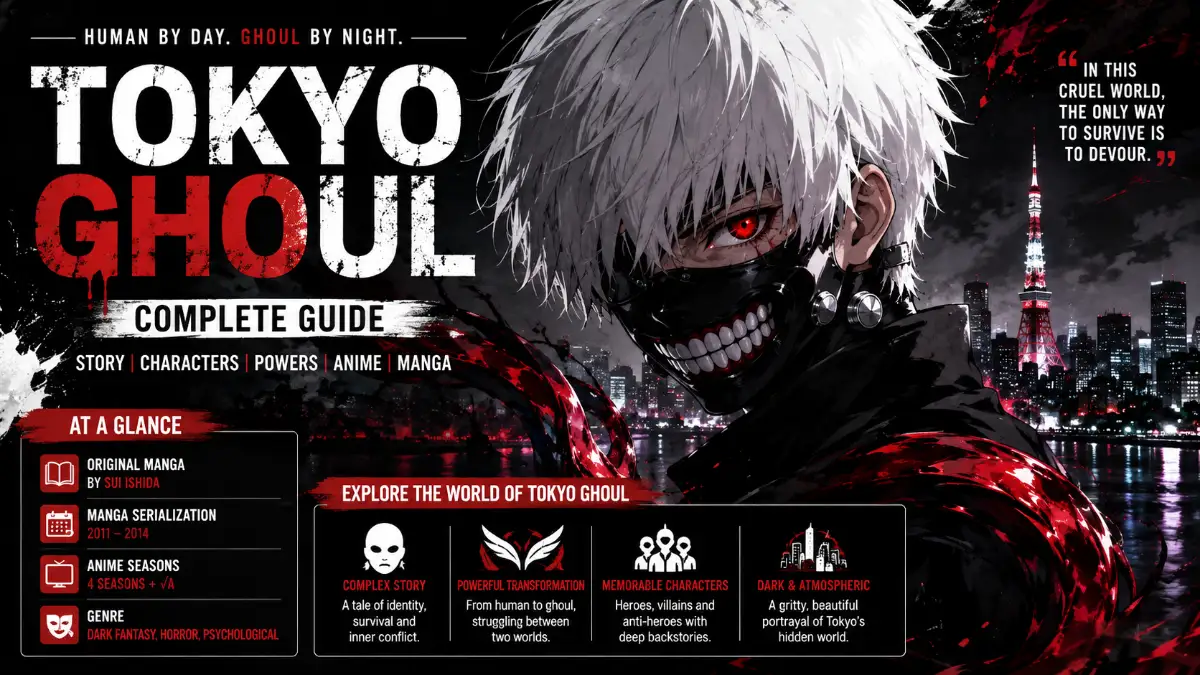
Tokyo Ghoul Manga is Sui Ishida’s completed dark fantasy series about Ken Kaneki, a quiet college student who becomes a half-ghoul and is pulled into the long-running conflict between ghouls and the CCG. The full core story spans 30 volumes in total, made up of 14 volumes of the original series and 16 volumes of its direct sequel, and this guide walks through the story, the main characters, the reading order, the arc structure, how the manga differs from the anime, and what actually happens at the end.
Whether you are completely new to the franchise, coming from the anime, or trying to figure out where the Tokyo Ghoul Manga series picks up after the show changes course, this guide is built to answer those questions directly and in order.
Tokyo Ghoul Manga at a Glance
| Detail | Information |
| Creator | Sui Ishida |
| Genre | Dark fantasy, horror, thriller |
| Original series | Tokyo Ghoul |
| Sequel | Tokyo Ghoul: re |
| Original volume count | 14 volumes |
| Sequel volume count | 16 volumes |
| Total core story | 30 volumes |
| Story status | Complete |
| Original publisher | Shueisha |
| English publisher | VIZ Media |
| Content note | Contains graphic violence and disturbing imagery; rated for older teen and adult readers |
What Is Tokyo Ghoul Manga?
Tokyo Ghoul takes place in a version of Tokyo where ghouls live hidden among ordinary people and must feed on human flesh to survive. Ghouls look human, form communities, and even build emotional lives, but their nature puts them in constant danger from the CCG, the government body created to hunt and eliminate them.
The series stands out because it never treats this premise as simple horror. Instead, it uses the ghoul-human divide to explore how identity, trauma, and prejudice shape people who are forced to live outside accepted categories. That thematic depth, combined with striking artwork and a tightly built cast, is why the manga became one of the defining dark fantasy titles of the last decade.
Tokyo Ghoul Story
The story begins when Ken Kaneki, an introverted literature student, goes on a date with a woman named Rize Kamishiro, unaware that she is a ghoul. After a near-fatal attack, Kaneki survives only because doctors transplant Rize’s organs into his body, unintentionally turning him into a half-ghoul. From that point forward, Kaneki has to learn how to survive with an appetite he cannot control and a body that no longer fully belongs to either world.
His path leads him to Anteiku, a small coffee shop that quietly functions as a safe space for ghouls trying to live peacefully. Through Anteiku’s staff and regulars, Kaneki learns how ghoul society actually works, including its internal hierarchies, its rivalries, and the constant threat posed by CCG investigators. As the story progresses, factions grow more extreme, alliances shift, and Kaneki is repeatedly forced to choose between the comfort of his old human life and the reality of what he has become.
The original manga ends with Kaneki fundamentally changed by the conflict, setting up Tokyo Ghoul: re, which follows him under a new identity and expands the story into a much larger political and emotional conflict. The sequel is where the series answers most of its long-term questions, including the fate of major characters and the future relationship between humans and ghouls.
Tokyo Ghoul Manga Characters
The cast is one of the biggest reasons readers stay invested, since very few characters remain simple heroes or villains for long. The table below covers the most important Tokyo Ghoul manga characters and why each one matters to the overall story.
| Character | Affiliation | Role | Why They Matter |
| Ken Kaneki | Central protagonist | Main lead | His transformation and moral struggle drive the entire series. |
| Touka Kirishima | Anteiku | Ghoul ally | One of the story’s strongest emotional anchors and a key figure in Kaneki’s arc. |
| Hideyoshi Nagachika | Human | Kaneki’s best friend | Represents his lingering human connection and loyalty across both series. |
| Rize Kamishiro | Independent ghoul | Catalyst | Her attack on Kaneki sets the entire plot in motion. |
| Shuu Tsukiyama | Ghoul society | Supporting character | Demonstrates the series’ range, blending obsession, comedy, and later genuine growth. |
| Koutarou Amon | CCG | Investigator | Brings moral complexity and doubt to the human side of the conflict. |
| Juuzou Suzuya | CCG | Investigator | One of the most distinctive characters, shaped by a traumatic past. |
| Haise Sasaki | CCG / Quinx era | Kaneki’s later identity | Central to understanding the structure and mystery of Tokyo Ghoul: re. |
| Kishou Arima | CCG | Elite investigator | His actions and history are tied to several of the series’ biggest revelations. |
| Eto Yoshimura | Ghoul / One-Eyed Owl | Major power player | A key figure behind the larger conflict shaping both series. |
This is not a complete character encyclopedia, but it covers the figures a new reader needs to recognize before moving into the arc breakdown and ending.
Tokyo Ghoul Manga Reading Order
The correct Tokyo Ghoul manga reading order is straightforward once you separate the essential story from optional side material.
Essential reading order
- Tokyo Ghoul
- Tokyo Ghoul: re
This is the complete core narrative. Reading only the first series leaves the story unresolved, since the sequel carries every major thread to its conclusion.
Optional supplementary reading
| Title | Type | When to Read | Required? |
| Tokyo Ghoul: JACK | Prequel side story | Before or alongside the main series | No |
| Tokyo Ghoul: Days | Novel | Optional supplemental reading | No |
| Tokyo Ghoul: Void | Novel | Optional supplemental reading | No |
| Tokyo Ghoul: Past | Novel | Optional supplemental reading | No |
| Tokyo Ghoul: JOKER | Side story | Around the transition into the sequel | No |
| Tokyo Ghoul: re Quest | Novel/side material | During or after Tokyo Ghoul: re | No |
Availability for these supplementary titles varies by region and edition, so it is worth checking current catalog listings before committing to them. None of them are required to understand the main plot or the ending, but they add background detail for readers who want a fuller picture of the world.
Tokyo Ghoul Manga Arcs
Tokyo Ghoul is commonly divided into several story arcs, although arc names and exact chapter boundaries can vary slightly between sources. The breakdown below reflects the arc structure most widely used by readers and reference guides, without forcing artificial chapter precision that risks misrepresenting where events actually occur.
Tokyo Ghoul arcs
| Arc | Main Events |
| Introduction Arc | Kaneki survives his encounter with Rize and becomes a half-ghoul. |
| Nishiki Arc | Kaneki has his first real confrontation with ghoul violence and begins learning to survive. |
| Doves’ Emergence Arc | The CCG’s presence becomes more prominent and dangerous. |
| Gourmet Arc | Tsukiyama’s obsession with Kaneki creates one of the series’ most memorable early conflicts. |
| Aogiri Tree Arc | A violent ghoul faction escalates the overall conflict significantly. |
| Post-Aogiri Tree Arc | The fallout reshapes alliances and pushes several characters toward darker choices. |
| Kanou’s Lab Arc | Hidden experiments and long-term manipulation come to light. |
| Disbanding Arc | Anteiku’s community faces its most serious internal and external pressure. |
| Owl Suppression Operation Arc | The original series reaches its most consequential large-scale conflict. |
| Epilogue | The first series closes and sets up the transition into the sequel. |
Tokyo Ghoul: re arcs
| Arc | Main Events |
| Torso Investigation Arc | Introduces the new status quo and Kaneki’s changed identity as Haise Sasaki. |
| Nutcracker Investigation Arc | Establishes the tone and stakes of the sequel’s early cases. |
| Auction Mopping-Up Operation Arc | A major rescue and combat operation centered on the ghoul auction. |
| Rose Investigation Arc | Expands the conflict into deeper faction politics and hidden history. |
| Tsukiyama Family Extermination Operation | The Tsukiyama family becomes central to a major tactical and emotional conflict. |
| Third Cochlea Raid / Rushima Landing Operation | A large-scale operation that shifts the balance of power significantly. |
| Clown Siege / CCG Lab Infiltration Arc | The conflict grows more chaotic as multiple factions collide. |
| 24th Ward Raid | The story moves into its final large-scale confrontations. |
| Dragon War Arc | The climactic conflict that resolves the series. |
Tokyo Ghoul vs Tokyo Ghoul: re
The difference between Tokyo Ghoul and Tokyo Ghoul: re goes beyond simple continuation. The original series is a more contained story about Kaneki’s transformation and early survival, while the sequel widens the scope into a full political and emotional resolution.
| Topic | Tokyo Ghoul | Tokyo Ghoul: re |
| Narrative focus | Transformation and personal survival | Identity, memory, factional conflict, and closure |
| Tone | Intimate horror and psychological pressure | Larger-scale war and eventual resolution |
| Cast | A smaller, tightly focused ensemble | An expanded cast built around the Quinx Squad and new factions |
| Reading role | First half of the story | Direct sequel and conclusion |
Readers who want the full meaning of Kaneki’s arc, including why certain choices matter, need both series. Treating them as one continuous story rather than two separate titles makes the pacing and character growth much easier to follow.
Manga vs Anime
One of the most common questions from newcomers is whether the Tokyo Ghoul manga is worth reading after watching the anime. It is, mainly because the manga is the more complete and internally consistent version of the story.
| Topic | Manga | Anime |
| Kaneki’s path after early events | Follows the canon manga route | Tokyo Ghoul √A significantly changes his direction |
| Character development | More detailed and gradual | Frequently compressed for time |
| Plot continuity | Consistent across both series | Several major events are altered or omitted |
| Tokyo Ghoul: re coverage | Full narrative progression | Heavily compressed adaptation |
Should anime viewers start the manga from Chapter 1?
Yes. Starting from the beginning is the safest and clearest option, even if you remember most of the first season. Because Tokyo Ghoul √A diverges from the source material, continuing from where the anime left off can create confusion about character motivations, relationships, and unresolved plot threads. Reading from Chapter 1 removes that risk entirely and lets the story’s pacing work the way it was originally intended.
Where to Read Tokyo Ghoul Manga
The official English source for Tokyo Ghoul manga is VIZ Media, which publishes both series digitally and in collected print volumes. Reading through an official source ensures accurate translations, proper chapter numbering, and support for the creator and publisher. Physical volumes are also widely available through major booksellers and libraries for readers who prefer a print collection.
Who Should Read Tokyo Ghoul?
Tokyo Ghoul is a strong fit for readers who enjoy dark fantasy, psychological horror, and morally complicated characters. It rewards patience, since some of its most meaningful character work unfolds gradually across both series rather than in a single dramatic moment.
It is a less comfortable fit for readers who prefer lighter, straightforward action stories, since the tone is frequently intense and emotionally heavy. The series contains graphic violence, body horror, and disturbing imagery, along with themes of trauma and loss that go beyond typical action-manga content. Readers sensitive to intense violence or psychological distress should approach it with that in mind.
Read more: For more in-depth guides and the latest updates, explore more on Chicuarotes.
Tokyo Ghoul Ending Explained
The Tokyo Ghoul Manga ending resolves the long-running conflict between humans and ghouls through Kaneki’s final confrontation during the Dragon War. Kaneki survives the crisis, and the story moves forward in time to show him married to Touka, with the two raising a daughter named Ichika. This final stretch reframes the entire series: after years of violence, loss, and identity crisis, Kaneki finally reaches a life built on stability and connection rather than survival alone.
The CCG’s role changes significantly by the end, shifting away from its earlier function as a purely militarized force against ghouls. Human-ghoul relations move toward a more open, if still imperfect, coexistence, reflecting the story’s long-standing argument that the two groups were never as fundamentally different as the CCG’s original framework suggested. The ending does not pretend the damage done throughout the series simply disappears; characters carry visible scars from what they lived through. Instead, the resolution is intentionally bittersweet, emphasizing that healing and a better future are possible even after prolonged conflict and loss.
Why Tokyo Ghoul Still Matters
Tokyo Ghoul remains widely read years after its conclusion because it combines distinctive visual style with genuinely layered character writing. Kaneki’s transformation works as both a horror premise and a metaphor for isolation, forced change, and the search for belonging, which gives the story relevance beyond its genre trappings.
The series also holds up on rereads. Once the full story and ending are known, early scenes involving Rize, Anteiku, and even minor CCG characters carry more weight, since details that seemed incidental on a first read often connect directly to later revelations. That density of connected detail is part of why the manga continues to attract new readers and ongoing discussion.
Frequently Asked Questions
Is Tokyo Ghoul manga finished?
Yes. The story is fully complete across Tokyo Ghoul and Tokyo Ghoul: re. Together, these two series make up the entire canon narrative, including the ending, and there is no ongoing serialization to follow.
How many volumes does Tokyo Ghoul manga have?
The original Tokyo Ghoul has 14 volumes, and Tokyo Ghoul: re has 16 volumes, bringing the complete core story to 30 volumes total. This does not include optional novels or side stories, which are separate from the main volume count.
What is the correct Tokyo Ghoul manga reading order?
Read Tokyo Ghoul first, then move directly into Tokyo Ghoul: re. This is the essential order for following the main plot from beginning to end, since the sequel continues directly from where the original series leaves off.
Should I read Tokyo Ghoul manga if I already watched the anime?
Yes, especially if you want the complete and accurate version of the story. The anime, particularly its second season, diverges from the manga in ways that change character outcomes and omit significant plot development found only in the source material.
Where should I start Tokyo Ghoul manga after watching the anime?
Start from Chapter 1. Because the anime’s later seasons change the story’s direction, beginning at the start of the manga avoids continuity confusion and lets you experience the intended pacing and character arcs without gaps.
What are the main Tokyo Ghoul manga arcs?
The original series includes arcs such as the Introduction, Nishiki, Gourmet, Aogiri Tree, and Owl Suppression Operation arcs. Tokyo Ghoul: re continues with arcs including the Auction Mopping-Up Operation, Tsukiyama Family Extermination, Rushima Landing Operation, and the concluding Dragon War arc.
Is Tokyo Ghoul manga appropriate for younger readers?
No, not for young children. The series contains graphic violence, body horror, and psychologically intense themes, making it more suitable for older teens and adult readers who are comfortable with mature horror content.
Is Tokyo Ghoul manga confusing for new readers?
It can feel complex once Tokyo Ghoul: re introduces new identities, factions, and layered political conflict. Reading the two series in order, rather than skipping ahead, makes the plot considerably easier to follow.
Is Tokyo Ghoul manga still worth reading?
Yes. It remains one of the more influential modern dark fantasy manga because of its distinctive art style, emotionally driven storytelling, and a premise that continues to resonate with readers interested in identity and moral complexity.
What makes Tokyo Ghoul: re essential to the story?
Tokyo Ghoul: re resolves nearly every major question left open by the original series, including the fates of key characters and the long-term direction of human-ghoul relations. Skipping it means missing the story’s actual conclusion, including the ending involving Kaneki, Touka, and their daughter.