Vending Machine: How It Works, Types, Costs, Technology and Business Basics
9 min read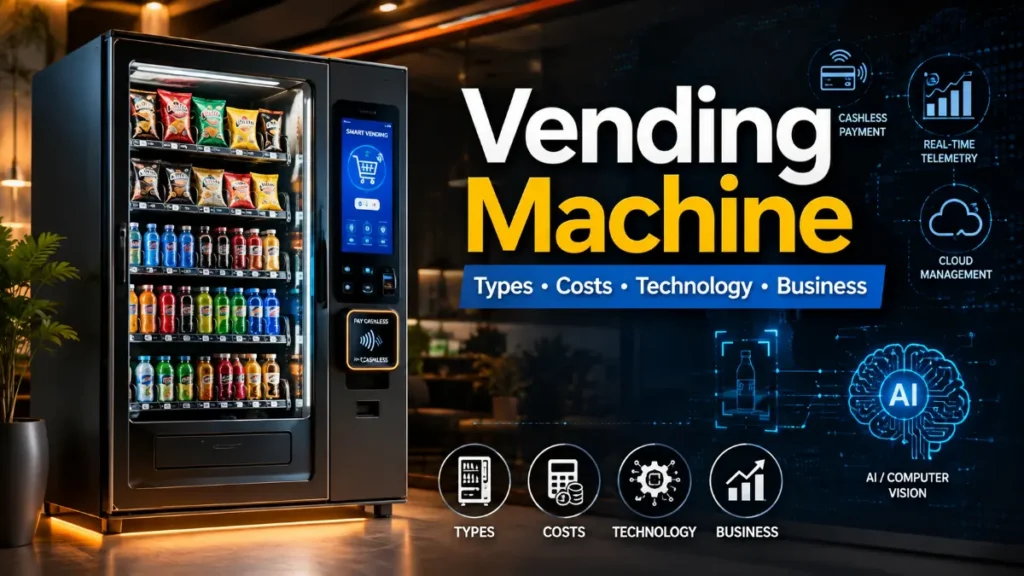
A Vending Machine is an automated retail system that lets customers purchase products without a traditional cashier. Depending on its design, it can sell drinks, snacks, fresh food, coffee, personal-care products, and other convenience items. Modern machines may accept cards and mobile wallets, monitor sales remotely, and connect to software that helps operators manage inventory and service.
The basic idea is simple: a customer selects a product, completes payment, and the machine releases the item. What has changed is everything surrounding that basic transaction. Today’s connected machines can collect transaction information, report faults, monitor temperatures and, in some formats, use computer vision to recognize products.
Understanding how the system works makes it easier to compare traditional equipment with smart vending, evaluate costs, and decide which format makes sense for a particular location.
What Is a Vending Machine?
A vending machine is a self-service retail device that stores products and automatically dispenses a selected item after the required payment or authorization is completed.
Traditional machines normally have several core components:
- Product storage compartments
- Selection buttons or a touchscreen
- A controller
- Motors or dispensing mechanisms
- A payment system
- A product-delivery area
- Sensors or switches
- A power supply
A modern unit can add a card reader, cellular modem, Wi-Fi, telemetry, refrigeration controls, cameras, and cloud-based management software.
The important distinction is that automation and artificial intelligence are not the same thing. A machine can be highly automated without using AI.
How Does a Vending Machine Work?
The transaction follows a relatively straightforward sequence, although the exact mechanism differs by machine type.
1. The customer chooses a product
The selection may be made through physical buttons, a keypad, a touchscreen, or another interface. The controller checks whether the selected product is available and confirms the price.
2. Payment is authorized
Depending on the equipment, payment can be made with coins, notes, a debit or credit card, contactless payment or a mobile wallet.
Cashless systems add a payment terminal and communications connection. The payment processor handles authorization before the machine releases the product.
3. The dispensing mechanism activates
In a conventional snack machine, a motor can rotate a spiral or another mechanism to move the product toward the delivery area.
Beverage machines can use different dispensing arrangements depending on bottle or can configuration.
Coffee machines and fresh-food equipment use substantially different mechanisms because they prepare or release products rather than simply pushing a packaged item forward.
4. The machine confirms the transaction
Some machines use sensors or motor feedback to determine whether the product was successfully dispensed.
This matters because a payment can be authorized while a mechanical problem prevents delivery. More sophisticated systems can use this information to support refunds or flag failed transactions.
5. The sale is recorded
Connected equipment can transmit sales and operational information to vending-management software.
This allows operators to see more than the amount of money collected. Depending on the setup, they may also see product sales, inventory estimates, machine alerts, and other operational data.
What Can a Vending Machine Sell?
The product assortment depends heavily on the machine’s physical design and location.
Common categories include:
| Machine format | Typical products |
| Snack machine | Chips, candy, cookies, nuts, and packaged snacks |
| Beverage machine | Water, soda, juice and energy drinks |
| Combination machine | Snacks and drinks |
| Coffee machine | Coffee, tea and hot beverages |
| Fresh-food machine | Meals, sandwiches, salads and other chilled products |
| Frozen machine | Frozen meals, desserts and other frozen goods |
| Specialty machine | Electronics, personal-care products or location-specific items |
| Smart cooler | Mixed chilled or grab-and-go products |
This is one reason there is no single “best” vending machine. A machine designed for bottled drinks is solving a different problem from one intended for fresh meals.
Main Types of Vending Machines
The traditional snack-and-drink format remains important, but unattended retail has expanded considerably.
Snack and beverage machines
These are the familiar enclosed cabinets found in workplaces, schools, hospitals, hotels and public facilities.
They are comparatively straightforward because the products are packaged, standardized and easy to store.
Combination machines
A combination vending machine combines different product categories in one cabinet. This can be useful where floor space is limited, but customers want both food and beverages.
Fresh-food machines
Fresh-food equipment needs more careful temperature control and inventory rotation. The operator must consider product shelf life in addition to sales volume.
In the United States, FDA vending-machine calorie-labeling requirements apply to operators owning or operating 20 or more machines, subject to specified conditions and exemptions.
Smart coolers and open-shelf retail
A smart cooler changes the shopping process. Instead of selecting one product through a numbered slot, customers can access products directly from a secured cooler and complete an automated checkout.
365 Retail Markets currently markets computer-vision systems such as PicoCooler Vision for this type of unattended retail.
Traditional vs. Smart Vending
A conventional vending machine can operate with limited information when leaving the cabinet. A smart system adds connectivity, data collection, and remote management.
| Feature | Traditional machine | Smart/connected machine |
| Payment | Cash or basic electronic payment | Cashless and mobile options |
| Inventory | Often checked physically | Remote reporting may be available |
| Machine faults | Often discovered during visits | Remote alerts can identify issues |
| Sales data | Basic or local | Centralized reporting |
| Connectivity | Not required | Usually connected |
| Computer vision | Rare | Available in some systems |
| Remote configuration | Limited | More common |
| Upfront complexity | Lower | Higher |
Smart equipment does not automatically produce higher profits. The benefit depends on whether the extra information and automation solve a real operational problem.
How Much Does a Vending Machine Cost?
There is no universal purchase price because equipment varies widely.
The total investment can include:
- Machine purchase or lease
- Delivery
- Installation
- Initial inventory
- Payment hardware
- Connectivity
- Software
- Permits or licenses where applicable
- Insurance
- Maintenance equipment
- Location-related costs
A used snack machine and a new refrigerated smart cooler should not be compared simply by sticker price.
For a business owner, total cost of ownership is more useful than the equipment price alone.
A cheaper machine can become expensive if it requires frequent repairs or physical inspections. Conversely, a more sophisticated machine may not make financial sense if sales volume is too low to justify the added technology.
Where Should a Vending Machine Be Placed?
Location is one of the strongest determinants of performance.
Good locations generally have some combination of:
- Consistent foot traffic
- Customers who spend time on-site
- Limited nearby alternatives
- Long operating hours
- A clear need for convenience
- Products that match the audience
Examples include workplaces, apartment communities, hotels, hospitals, gyms, and certain transportation facilities.
But raw foot traffic is not enough.
A busy hallway where people rarely stop may produce fewer sales than a smaller workplace break area where customers have several minutes to decide what to buy.
The right product mix also matters. A gym may favor water, sports drinks, and convenient snacks. An office may have stronger demand for coffee and everyday refreshments.
How Smart Technology Changes Operations
A connected vending machine can reduce the amount of guesswork involved in managing a fleet.
Telemetry can transmit information such as:
- Sales
- Payment activity
- Machine status
- Fault conditions
- Temperature information
- Inventory-related data
Vending-management software can then help operators organize routes and decide which machines need attention.
This does not remove physical work. Someone still has to transport products, restock shelves, clean equipment, and repair mechanical problems.
The advantage is better prioritization.
Instead of treating every machine on a route identically, an operator can use available data to focus on the machines most likely to require service.
Is AI Used in Vending Machines?
Yes, but the term is frequently broader than the technology itself.
Computer vision is one genuine application. In smart coolers and open-shelf systems, cameras and software can identify products selected by customers.
AI or machine-learning techniques can also support demand forecasting and other analytics.
However, a card reader, touchscreen, or remote dashboard does not automatically mean the machine is using artificial intelligence.
A useful buyer should ask exactly what the AI feature does and what data it needs.
Is a Vending Machine Business Profitable?
A vending machine can generate revenue, but profitability is highly dependent on location, product margin, transaction volume, and operating costs.
The basic calculation is:
Net operating profit = sales – product costs – location costs – payment/software fees – maintenance – labor/logistics – other expenses
A machine selling a large number of high-margin products in a strong location can have a very different result from an identical machine in a low-demand location.
This is why claims about guaranteed monthly profits should be treated skeptically.
The business is also not completely passive. Stocking, route planning, product purchasing, customer support, and repairs remain necessary.
What Regulations Apply?
Requirements depend on the country, state, province, and municipality.
For U.S. operators, the FDA has specific calorie-labeling requirements for covered vending operators owning or operating 20 or more machines, subject to exceptions.
Other requirements can involve:
- Business registration
- Local permits
- Food safety
- Sales tax
- Insurance
- Accessibility
- Electrical requirements
- Refrigeration standards
- Privacy rules for camera-enabled systems
Operators should verify requirements with the relevant authority instead of assuming that rules applying in one location apply everywhere.
Read more: Vending Machine: How It Works, Types, Costs, Technology and Business Basics
What Does the Future of Vending Look Like?
The vending machine is becoming part of a broader unattended-retail ecosystem.
Traditional cabinets are increasingly being joined by smart coolers, micro markets, connected payment systems and computer-vision checkout. In March 2026, 365 Retail Markets announced VisionLink, a system designed to let shoppers move between multiple smart-store doors while using one transaction authorization.
That illustrates the broader direction: more flexible product access, more connected equipment, and fewer barriers between vending and small-format unattended retail.
The future is unlikely to be one universal machine that replaces every traditional unit. Different locations will continue to need different formats.
The best technology is the technology that fits the product, customer, location, and operating model.
Frequently Asked Questions
What is a vending machine?
A vending machine is an automated retail device that stores products and dispenses them after a customer completes a required payment or authorization.
How does a vending machine work?
The customer selects an available product, completes payment, and the machine activates a dispensing mechanism. Sensors or machine controls may then confirm the vend and record the transaction.
What are the most common types of vending machines?
The most common formats include snack machines, beverage machines, combination machines, coffee machines, and specialized refrigerated or fresh-food equipment.
Can vending machines accept contactless payments?
Many modern machines can accept contactless cards and mobile wallets through compatible payment terminals. The available methods depend on the payment hardware and market.
Do vending machines use AI?
Some modern systems use AI or machine learning for computer vision, product recognition, and demand analysis. Traditional machines generally rely on predefined mechanical and electronic controls.
Are smart vending machines better than traditional machines?
Not automatically. Smart equipment is more useful when remote monitoring, cashless payments, inventory intelligence, or computer vision solve a genuine business problem.
How much does a vending machine cost?
Costs vary significantly depending on machine type, condition, capacity, and technology. The total investment can also include delivery, installation, inventory, payment equipment, software, and maintenance.
Where is the best place for a vending machine?
Locations with consistent demand, suitable dwell time, limited nearby alternatives, and a strong product-location match are generally more attractive than locations chosen solely for high foot traffic.
Is a vending machine business passive income?
It can be partially automated, but it is not completely passive. Operators still need to handle inventory, restocking, maintenance, route planning, location relationships, and customer issues.
What should I check before buying a vending machine?
Check the product capacity, payment options, power requirements, refrigeration needs, service availability, software compatibility, expected operating costs, and whether the machine suits the intended location.
Final Verdict
The modern vending machine is best understood not as a single piece of equipment but as a small automated retail system. Traditional mechanical dispensing remains useful, while connected payments, telemetry, and computer vision are expanding what unattended retail can do. For buyers and operators, the smartest choice is rarely the machine with the longest feature list. It is the one that delivers the right capabilities for the location at a sustainable cost.