
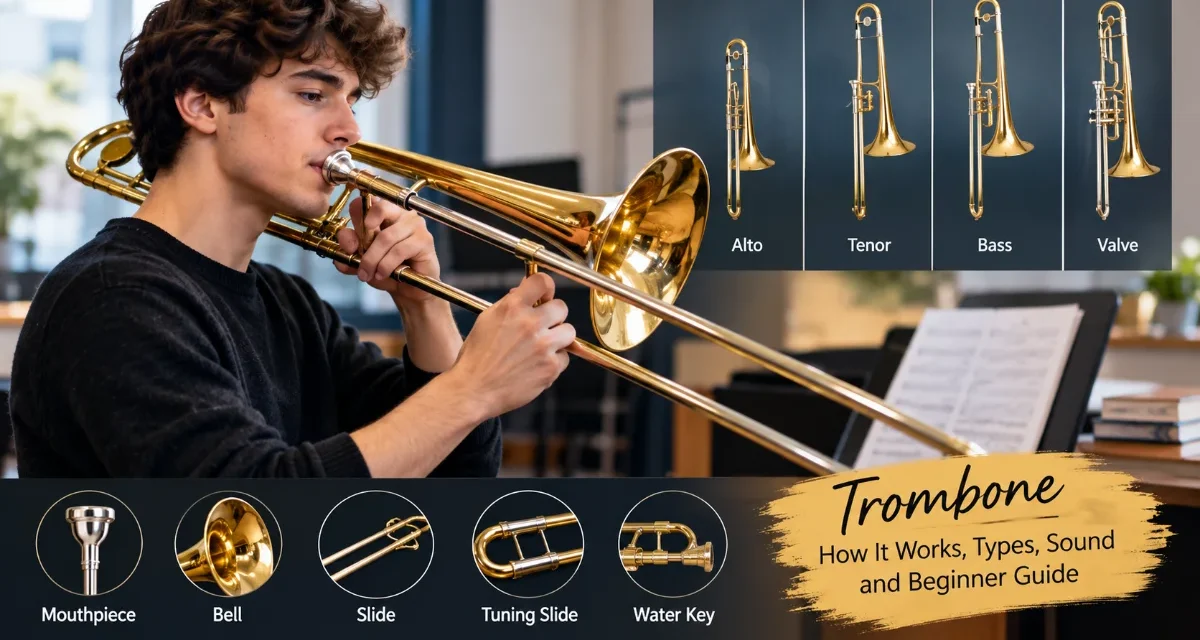

A trombone is a brass instrument that produces sound when a player buzzes their lips into a mouthpiece and controls the airflow. Unlike a trumpet or euphonium, a standard trombone changes pitch primarily through a movable slide that lengthens or shortens the instrument’s tubing. Its history dates back to the 15th century, when an early form of the instrument was known as the sackbut. Today, trombones feature in orchestras, jazz bands, concert bands, marching bands, and other musical ensembles.
The trombone can produce warm, mellow tones as well as bright, powerful sounds. Learning to play requires coordination between breathing, lip control, listening, and accurate slide movement. Understanding its parts, types, and basic techniques can help beginners decide whether it is the right instrument for them.
How Does a Trombone Work?
A trombone produces sound through a combination of lip vibration, airflow, and changes in tubing length. When a player blows into the mouthpiece, their vibrating lips set the air column inside the instrument in motion. The instrument resonates at particular pitches, and the bell helps project the sound outward.
On a standard slide trombone, moving the slide outward lengthens the tubing and generally lowers the pitch, while moving it inward shortens the tubing and raises the pitch. The instrument has seven conventional slide positions, each capable of producing multiple notes. The slide determines the available pitches, while the player’s embouchure, airflow, and control of the harmonic series help determine which note sounds. Yamaha’s guide to trombone slide positions explains how these elements work together.
Unlike a trumpet, which uses valves to change the effective tubing length, a standard trombone allows the player to adjust the tubing directly with the slide. This design also makes smooth transitions between pitches, known as glissandos, possible.
What Are the Main Parts of a Trombone?
Each part of a trombone contributes to producing sound, adjusting pitch, or making the instrument easier to handle.
- Mouthpiece: The player buzzes their lips against it to start the sound.
- Bell: The flared end that projects the sound.
- Inner and outer slide: The sliding tubes that change the effective tubing length and pitch.
- Slide brace and handle: Help the player hold and move the slide.
- Tuning slide: Allows adjustments to the instrument’s overall tuning.
- Water key: Releases accumulated moisture from condensation.
- F attachment (on some models): A valve and additional tubing that provide alternative slide-position options and access to additional lower notes.
Not every trombone includes an F attachment. Its presence depends on the model and intended use.
What Are the Different Types of Trombones?
Trombones vary in pitch, size, design, and musical purpose. Four commonly discussed types are alto, tenor, bass, and valve trombones.
| Type | Main characteristics | Typical uses |
| Alto trombone | Higher-pitched and generally smaller | Selected orchestral and solo repertoire |
| Tenor trombone | Versatile, standard slide trombone | School bands, jazz, concert bands, and orchestras |
| Bass trombone | Typically has a larger bore and bell, with valve attachments common on modern models | Orchestral bass parts, jazz, and low-brass sections |
| Valve trombone | Uses valves instead of a hand slide | Selected jazz, wind-band, and specialist music |
The tenor trombone is generally a practical starting point for beginners because it is widely used and has extensive educational material available. The bass trombone supports lower-register parts, while the alto trombone handles higher parts in certain ensembles. The Philharmonia’s trombone guide explains the roles and characteristics of the main slide trombone sizes.
A valve trombone differs primarily in how it changes pitch. Its valves redirect air through additional tubing, much like those of a trumpet. It is not simply another name for a bass or alto trombone.
How to Play the Trombone: A Beginner’s Guide
Learning the trombone starts with a comfortable playing position, controlled breathing, and basic slide coordination. Beginners should focus on producing a steady tone before attempting complicated music.
1. Maintain Good Posture
Sit or stand upright with relaxed shoulders. Support the instrument securely with your left hand and move the slide smoothly with your right hand. Keep your wrist relaxed and avoid gripping the slide too tightly.
2. Develop Your Embouchure and Breathing
The embouchure is the way you position and use your lips against the mouthpiece. Start with a relaxed lip buzz and steady airflow. Avoid pressing the mouthpiece too firmly against your lips or forcing the air to reach higher notes.
A music teacher can help identify tension and inefficient technique before they become habits.
3. Learn the Seven Slide Positions
Practice moving the slide through its seven conventional positions, starting with comfortable notes and simple exercises. Use a tuner and listen carefully to check your pitch.
Unlike the frets on a guitar, trombone slide positions are not marked on the instrument. Players learn their placement through listening, muscle memory, and repeated practice. Exact slide placement can vary slightly depending on the note, instrument, and playing conditions.
4. Follow a Consistent Practice Routine
Short, regular practice sessions help beginners build control and consistency. A routine can include:
- Gentle breathing and warm-up exercises.
- Sustained notes to develop a stable tone.
- Simple scales and slide-position exercises.
- Easy melodies that combine reading music with slide movement.
- Reviewing difficult passages and correcting pitch problems.
Increase the difficulty gradually as your tone, accuracy, and endurance improve.
5. Clean and Store the Instrument Properly
Remove accumulated moisture after playing, and keep the slide clean and appropriately lubricated. Wipe the exterior with a soft cloth, handle the slide carefully, and store the instrument in a protective case.
Follow the manufacturer’s care instructions for cleaning products and periodic maintenance. For example, Yamaha’s trombone maintenance guide covers slide care and moisture removal. A damaged or misaligned slide may require professional repair rather than forceful adjustment.
Trombone vs. Trumpet vs. Euphonium
Although all three instruments belong to the brass family, they differ in how players change pitch, their sound characteristics, and their musical roles.
| Feature | Trombone | Trumpet | Euphonium |
| Pitch control | Usually a hand slide | Valves | Valves |
| Typical sound | Broad, warm, or powerful | Bright and penetrating | Warm, rounded, and full |
| Common role | Harmony, melody, and low-brass parts | Melody, fanfares, and high-brass parts | Low-brass melody and supporting harmony |
| Beginner challenge | Coordinating slide movement and accurate pitch | Developing lip control and valve coordination | Managing breath, embouchure, and valve technique |
No instrument is universally easiest to learn. Trombone players must coordinate slide movement with accurate pitch, while trumpet and euphonium players coordinate their valves with breathing and embouchure.
How to Choose Your First Trombone
For most beginners, a standard tenor student trombone is a sensible starting point unless a teacher or specific musical requirement suggests otherwise. Before buying, consider these factors:
- Condition: Check for dents, corrosion, leaks, and a slide that moves smoothly.
- Comfort: Make sure you can reach the slide positions without straining.
- Tuning and playability: Ask a music teacher or experienced player to test the instrument if possible.
- New versus used: A used instrument may offer good value, but repair costs can offset the savings.
- Rental options: Renting through a music store or school can be a practical way to try the instrument before committing to a purchase.
- Maintenance supplies: Budget for suitable slide lubricant, cleaning accessories, and a protective case if these are not included.
Avoid choosing solely by appearance or price. A well-maintained instrument that fits your needs is more useful than a cheaper model with mechanical problems.
Frequently Asked Questions
Is the trombone difficult to learn?
The trombone can be challenging at first because players must coordinate breathing, lip vibration, and slide position. Consistent practice and good instruction help beginners develop a steady tone and accurate pitch gradually.
Is the trombone suitable for beginners?
Yes. A tenor trombone is a common starting instrument for students and adult beginners. Choose a model that is comfortable to hold, has a smooth slide, and suits your physical reach and musical goals.
What is the difference between a trombone and a trumpet?
A standard trombone uses a movable slide to change tubing length, while a trumpet uses valves. The trumpet generally plays higher parts, whereas the trombone is versatile across middle and lower brass registers.
What should you consider when buying your first trombone?
Prioritize a smooth slide, reliable playability, comfortable reach, good condition, and access to maintenance or repairs. Consider renting before buying, especially if you are unsure whether you will continue playing.