EV Charger Installation: Complete Homeowner Guide to Choosing, Planning, and Installing a Home Charger
8 min read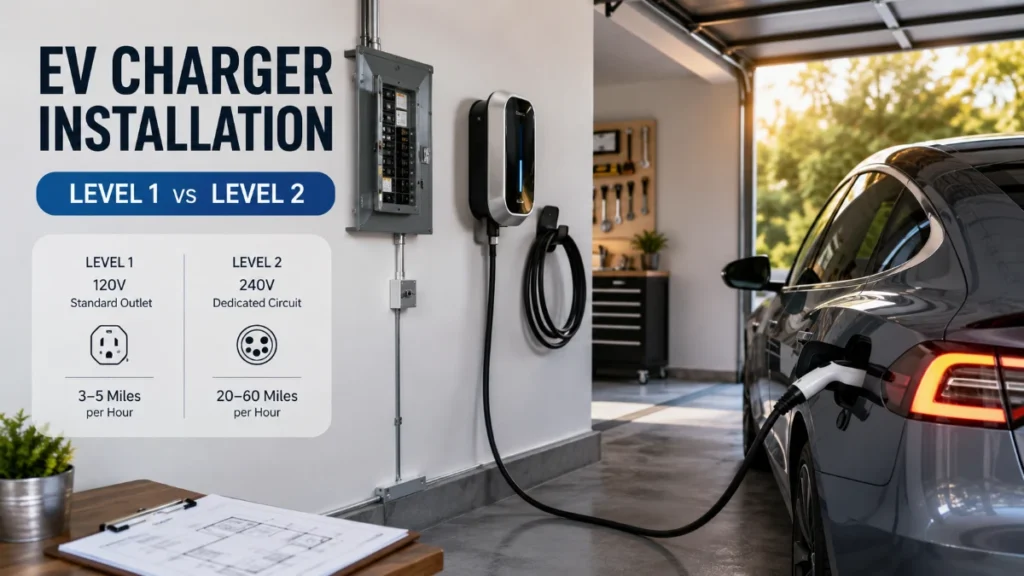
If you are planning EV Charger Installation at home, the most important decision is not which charger has the highest amperage. The better approach is to match the charger to your EV, daily driving, parking time, electrical service, and installation location. A properly planned system can provide convenient overnight charging without paying for electrical upgrades or charging capacity you do not actually need.
For most U.S. homeowners, the practical choice is between Level 1 and Level 2 AC charging. Level 1 generally uses a suitable 120-volt household connection, while residential Level 2 normally uses 240-volt power and provides substantially faster charging. The U.S. Department of Energy estimates roughly 2–5 miles of range per hour for Level 1 and about 10–30 miles per hour for Level 2, although actual results vary by vehicle and conditions.
Which Home Charging Level Should You Choose?
Home charging works best when the charging rate matches the amount of energy your vehicle typically needs while parked. Buying the most powerful EVSE available can increase electrical requirements without providing a meaningful benefit if your vehicle or daily routine does not need it.
| Charging option | Typical U.S. electrical supply | Best for | Main limitation |
| Level 1 | 120V AC | PHEVs, lower mileage, long parking periods | Slow charging |
| Level 2 | 240V AC | Most BEVs and regular overnight charging | Requires more substantial electrical installation |
| DC fast charging | High-capacity infrastructure | Public, fleet, commercial use | Usually impractical for a normal home |
When Level 1 makes sense
Level 1 is sometimes enough for drivers who travel modest distances and leave their vehicle parked overnight.
It can work particularly well when:
- Your daily mileage is modest.
- The vehicle remains parked for many hours.
- You drive a plug-in hybrid.
- You do not regularly need to recover a large amount of energy quickly.
- A suitable 120V circuit is available.
There is no incentive to install Level 2 if Level 1 already meets your needs.
When Level 2 is worth considering
Level 2 becomes more attractive when you drive more frequently, have a battery-electric vehicle, or want a dependable way to replenish substantial energy overnight.
Before buying one, check your vehicle’s maximum AC charging capability. A high-output EVSE cannot make a vehicle accept more power than its onboard AC charging system allows.
What Does a Home EV Charger Actually Include?
The wall-mounted equipment is commonly called a charger, but technically it is usually electric vehicle supply equipment (EVSE).
For AC charging, the EVSE controls and safely supplies electricity to the vehicle. The vehicle’s onboard charger then converts the incoming AC electricity into DC energy used by the battery.
That distinction explains why buying a more powerful EVSE does not automatically result in faster charging.
A useful way to think about the system is:
Vehicle capability + EVSE output + electrical circuit + home service = usable charging performance
The weakest appropriate component limits the practical result.
What Does an Electrician Check Before Installation?
A professional site assessment should go beyond finding an empty breaker position.
The electrician may evaluate:
- Main service rating
- Existing household electrical demand
- Panel condition
- Available breaker space
- Calculated load capacity
- Proposed charging current
- Circuit route
- Conductor requirements
- Grounding and protection
- Charger location
- Permit requirements
- Future EV plans
DOE states that home charging installations need to comply with applicable codes and regulations and recommends using a licensed electrical contractor. Local permitting requirements vary.
Panel space is not the same as capacity
This is one of the most important points for homeowners.
An empty breaker slot tells you that there may be physical room for equipment. It does not prove that the electrical service can support another major continuous load.
The reverse is also possible. A crowded panel does not automatically mean the entire service must be replaced.
Depending on the calculated load, the solution might involve:
- A lower charging current
- Load management
- A subpanel
- Panel replacement
- Service upgrade
- Another compliant circuit arrangement
Why the Circuit Matters
Level 2 charging generally uses a dedicated branch circuit. EV charging can continue for several hours, so the circuit must be designed for continuous operation under the applicable electrical requirements.
For example, if the continuous charging current is 32 amps, applying a 125% continuous-load factor produces:
32A × 1.25 = 40A
This illustrates the principle rather than providing a DIY wiring instruction. The actual breaker, conductor, receptacle, protection, and installation method must be selected according to the EVSE instructions, applicable code, and site conditions.
There is also no universal EV charger wire size. Conductor selection can depend on material, insulation, distance, installation method, temperature, conduit configuration, terminal ratings, and local requirements.
Where Should You Put the Charger?
The closest possible location to the panel is not necessarily the best charging location.
The EVSE should be positioned where the cable comfortably reaches the vehicle without creating unnecessary strain, trip hazards, or interference with doors and parking.
Consider:
- Charge-port location
- Cable length
- Garage door movement
- Vehicle alignment
- Pedestrian paths
- Storage areas
- Outdoor exposure
- Risk of vehicle impact
- Future vehicle changes
A slightly longer electrical route may be worthwhile if it creates a much better daily charging experience.
Detached garages need more planning
A detached garage can require underground conduit, trenching, additional distribution equipment, and restoration work.
If excavation is necessary, ask whether future capacity should be considered during the same project. Depending on the design, planning for another charging location can be easier before the ground is restored.
Outdoor charging is possible
Outdoor EVSE should be specifically suitable for the environment and installed according to the manufacturer’s instructions.
DOE recognizes outdoor charging as a normal use case when equipment and installation are appropriate.
Pay attention to water exposure, physical impact, cable storage, drainage, and vehicle movement.
Hardwired vs. Plug-In EVSE
A hardwired unit connects directly to the branch circuit. A plug-in unit connects through a suitable receptacle.
Neither is automatically the better choice.
Hardwired can be attractive when:
- You want a permanent installation.
- The EVSE is designed for hardwiring.
- You want to avoid relying on a frequently used receptacle.
- The equipment configuration favors direct connection.
Plug-in can be attractive when:
- Portability matters.
- The EVSE supports the intended receptacle.
- A suitable receptacle can be installed correctly.
- You may replace or relocate the equipment later.
Never assume an existing 240V outlet is suitable simply because the plug fits.
A Practical EV Charger Installation Process
A well-planned project usually follows this sequence:
1. Calculate your charging need
Estimate daily mileage and how long the vehicle normally remains parked.
2. Check the EV specifications
Confirm maximum AC charging power, connector, and recommended charging configuration.
3. Select the EVSE
Choose equipment that fits the vehicle and intended electrical setup rather than simply selecting the highest advertised output.
4. Assess the electrical system
Have the electrician evaluate panel capacity, existing loads, circuit requirements, and wiring route.
5. Select the installation location
Make sure the cable reaches comfortably, and the equipment is protected from avoidable hazards.
6. Confirm permits
Ask the electrician or local authority whether an electrical permit and inspection are required.
7. Install and configure
The EVSE should be installed according to its instructions and configured for the installed circuit.
8. Test and document
Keep the invoice, equipment information, permit documents, inspection record, and warranty details.
How Can You Avoid Paying for More Charger Than You Need?
Consider two drivers.
Driver A travels 25–30 miles most days and parks at home for 11 hours.
Driver B travels 100 miles regularly and has only six hours available for overnight charging.
Driver B has a stronger reason to prioritize charging power. Driver A may have little practical benefit from a much higher-output installation.
This is the central principle of home charging:
Choose charging capacity based on the energy you need to replace and the time available to replace it.
That approach can also reduce unnecessary pressure on the home’s electrical service.
What About Two EVs?
Two EVs do not necessarily mean two chargers operating at maximum output simultaneously.
Some charging systems support load sharing or energy management. The available electrical capacity can be distributed between vehicles rather than allowing both to draw maximum power at the same time.
That can be useful when both cars are normally parked for long periods.
The objective is not maximum simultaneous output. It is sufficient energy delivered before the vehicles are needed again.
Read more: EV Charger Installation: Complete Homeowner Guide
Permits, Safety, and Equipment Quality
A safe installation requires more than a correctly sized circuit.
Homeowners should verify that:
- The EVSE is suitable for the intended market.
- The equipment is appropriately listed or certified.
- Installation follows manufacturer instructions.
- Required electrical protection is provided.
- The circuit is correctly designed.
- Required permits are obtained.
- Required inspections are completed.
- The final charging current matches the installation.
UL Solutions identifies ANSI/UL 2594 as a standard for electric vehicle supply equipment.
Avoid makeshift extension-cord arrangements, damaged receptacles, improvised adapters, or unknown circuits for routine charging.
Frequently Asked Questions
How much does EV charger installation cost?
The total depends on the EVSE, circuit work, wiring distance, labor, permits, and electrical upgrades. Current U.S. estimates vary substantially by property, so a site-specific quote is more useful than one national average.
Do I need Level 2 charging at home?
Not necessarily. Level 1 can be adequate for some lower-mileage drivers and plug-in hybrids. Level 2 is more useful when you need faster overnight recovery.
Does every Level 2 charger need a 240V connection?
Residential Level 2 charging typically uses 240V service in the United States, although the exact electrical configuration depends on the equipment and installation.
Can my 100-amp electrical service support an EV charger?
Possibly. The service rating alone is not enough to answer the question. A load assessment should consider existing household demand and the proposed charging load.
Can I install an EV charger outdoors?
Yes, when the EVSE is rated for outdoor use and installed appropriately.
Is hardwired better than plug-in?
Neither is universally better. The choice depends on the equipment, electrical design, portability requirements, and local requirements.
Can two EVs charge from one home’s electrical service?
Yes. Load sharing or managed charging may allow two vehicles to share available capacity.
Do I need an electrician?
For a permanent Level 2 installation, professional electrical installation is the appropriate approach, particularly where new circuits, panel work, or permitting are involved.
Can I use an existing dryer outlet?
Do not assume so. The circuit, receptacle, breaker, wiring, grounding, and load must be evaluated for EV charging.
How long does installation take?
A straightforward installation may be completed relatively quickly, while projects involving long wiring routes, trenching, panel work, or inspections can take longer.
Final Verdict
The best home charging system is not necessarily the fastest one. It is the one that matches your vehicle, driving routine, electrical capacity, parking layout, and future needs. Planning those pieces before installation can prevent unnecessary spending and make daily charging almost effortless.