
Full Size Mattress Buying Guide: Fit, Comfort, and Value Explained
12 min read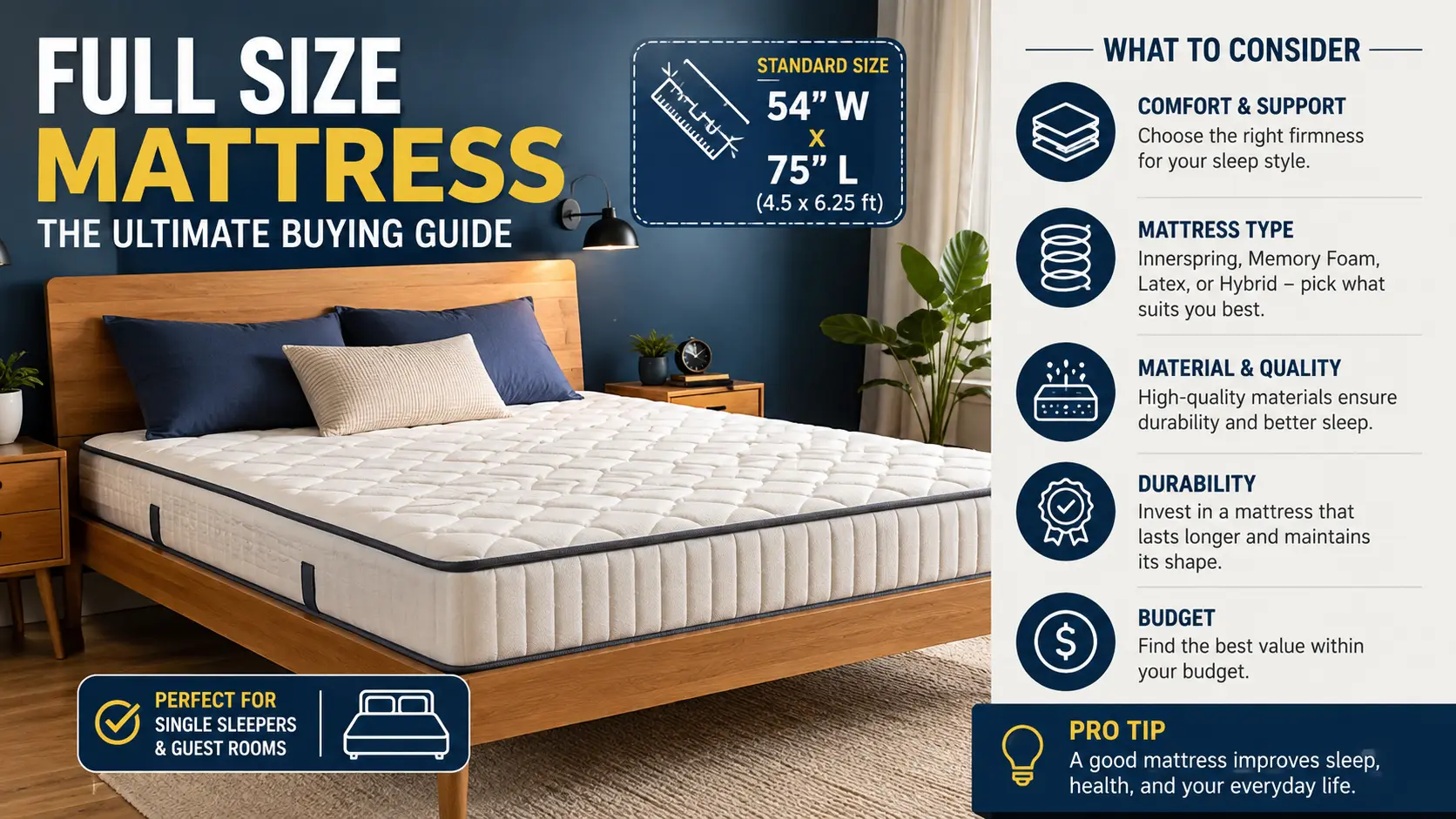
Picking a mattress size feels like it should be the easy part of furnishing a bedroom, yet it’s often where shoppers get stuck. A full-size mattress – 54 by 75 inches, also commonly called a double mattress – sits in the middle of the standard size lineup: bigger than a twin, more affordable than a queen, and comfortable for the right sleeper while frustrating for the wrong one. This guide walks through where a full-size mattress fits into a real bedroom, when it earns its keep, and what to verify before you commit to buying one.
Is a Full Size Mattress Right for You?
Choose a full if you’re a solo sleeper, furnishing a teen or guest bedroom, working with a smaller bedroom footprint, or prioritizing a lower upfront cost. Lean toward a queen instead if you share a bed nightly with a partner, you’re a taller sleeper, a child or pet regularly co-sleeps with you, or you expect your household situation to change in the next few years.
Full Size Mattress Dimensions
| Unit | Width | Length |
| Inches | 54″ (some brands list 53″) | 75″ |
| Centimeters | ~137 cm | ~191 cm |
| Feet | 4.5 ft | 6.25 ft |
| Surface area | ~28.1 sq. ft. (4,050 sq. in.) |
Exact listed dimensions can vary slightly by manufacturer – some brands list their full mattress at 53 inches wide rather than 54. This isn’t a defect, just a difference in how each brand specifies its product, and it’s too small to meaningfully affect frame or bedding fit. Always check the specific mattress and frame dimensions before buying, especially when pairing pieces from different brands.
How the Full Compares to Its Nearest Neighbors
| Feature | Twin | Twin XL | Full | Queen |
| Width | 38″ | 38″ | 54″ | 60″ |
| Length | 75″ | 80″ | 75″ | 80″ |
| Good for couples? | No | No | Not recommended long-term | Yes |
| Good for taller sleepers? | No | Yes | Limited | Yes |
| Fits a small room? | Yes | Yes | Yes | Depends on layout |
Full Size Mattress Pros and Cons
| Pros | Cons |
| More width than a twin or Twin XL | Same 75″ length as a twin, which can limit taller sleepers |
| Smaller footprint than a queen | Tight for most couples sharing nightly |
| Usually cheaper than a queen | Less future-proof if your household situation changes |
| Widely available bedding and frames | Less spreading room than larger sizes |
Three Scenarios Where a Full Size Bed Makes Sense
The solo apartment dweller. Living alone in a studio or one-bedroom without room for a queen, a full gives noticeably more stretch-out space than a twin without crowding out a desk, dresser, or seating area.
The outgrown teen bedroom. Kids who’ve spent years in a twin often feel cramped by their mid-teens. A full solves that without the cost jump to queen and typically suits a standard teen bedroom’s footprint.
The occasional guest room. A full strikes a practical balance in rooms that host visitors a few nights a month, offering solid comfort without dedicating a large room to a bed that sits empty most of the year.
Who Should NOT Buy a Full Size Mattress
- Couples sharing a bed nightly – the width doesn’t scale to two adults as comfortably as a queen.
- Taller sleepers who stretch out – many solo sleepers are comfortable up to roughly 6 feet, but the 75-inch length offers little buffer beyond that; compare an 80-inch Twin XL, Full XL, or queen instead.
- Regular co-sleepers with kids – a child sharing the bed on top of an adult partner leaves very little usable space.
- Households with a large pet that shares the bed – the same width constraint applies.
- Buyers who expect their situation to change soon – a full doesn’t scale gracefully if you later need room for a partner.
The Six-Inch Question: Full vs. Queen
A full provides about 27 inches of width per sleeper when shared by two adults, compared with 30 inches each on a queen. That three-inch-per-person difference, combined with the queen’s extra five inches of length, is generally what makes a queen more practical for nightly sharing – a queen offers roughly 18% more total sleeping surface than a full.
| What You’re Solving For | Full | Queen |
| Budget is the top priority | Better fit | Costs more |
| Limited floor space | Usually easier to fit | Needs ~6″ more width, 5″ more length |
| Sleeping alone | Comfortable for most | More than enough |
| Sharing nightly with a partner | Tight | Comfortable for most couples |
| Might need it for two people eventually | Less future-proof | More future-proof |
Are a full and double mattress the same size? Yes – full and double refer to the same 54 x 75-inch mattress. Double is the older term, and full is now more commonly used in U.S. retail listings, but the two are interchangeable.
Full XL and Other Size Variations
Full XL keeps the same width but stretches to about 80 inches long – matching a queen’s length while staying narrower. It’s a niche product most physical stores don’t stock, so expect to shop online or through specialty mattress makers; a tall solo sleeper who likes a full’s footprint but not its length often finds this a better fix than jumping to queen width. One trade-off: full-size sheets, protectors, and frames are widely available, but Full XL accessories are considerably less common.
Don’t confuse a full with a three-quarter bed (roughly 48 x 75 inches), an uncommon legacy size found mainly with older or vintage frames; standard full-size mattresses and bedding won’t fit one.
Full-Size Bedding and Frame Considerations
Standard full-size sheets, comforters, and mattress protectors are widely stocked across nearly every home goods retailer, so outfitting a full bed rarely requires special ordering unless you’ve chosen a Full XL or an unusually thick mattress. When shopping for sheets, check the fitted sheet’s pocket depth against your mattress’s actual height rather than assuming “full size” alone guarantees a secure fit – a sheet rated for a shallow profile will slip loose on a taller pillow-top mattress.
Bed frames built for a full typically measure a few inches larger than the mattress itself, usually in the range of 56 to 59 inches wide and 77 to 80 inches long, to leave a small margin around the mattress edges. Platform beds, traditional frames paired with a box spring, and adjustable bases are all manufactured in full size, so the choice mostly comes down to desired height, storage needs, and support style rather than availability. If you’re placing a new mattress on an older or inherited frame, measure the interior rail dimensions directly rather than trusting a general size label, since older frames sometimes use slightly different specifications than current manufacturing standards.
Full Size Memory Foam Mattress: Is It the Right Pick?
Memory foam is one of the most popular constructions for full-size shoppers specifically, and the reasons are tied directly to the size itself. Because a full already has less usable width than a queen, foam’s close body contouring can make the surface feel more supportive at the edges of a sleeper’s range of motion than a thinner, bouncier innerspring layer might. It also isolates motion well, which matters if the mattress will occasionally be shared with a partner, child, or pet.
The trade-off is heat retention. Traditional memory foam traps body heat more than hybrid or innerspring builds, though gel-infused or open-cell foam formulations reduce this effect meaningfully. If you run warm at night, look specifically for these cooling features rather than assuming all memory foam performs the same way, since formulation quality varies widely between brands and price tiers.
A full-size memory foam mattress also tends to weigh less than the same construction in queen or king, which makes it easier to rotate, flip if the model calls for it, or move during a future apartment change. For adults who sleep alone and want close-contouring pressure relief without paying for a larger size, memory foam is consistently one of the strongest matches for the full-size footprint.
What Makes a Full Size Mattress Worth Buying for Adults
Full mattresses for adults work best when the buyer’s priorities line up with what the size is actually built for: solo comfort, budget efficiency, and a manageable footprint rather than maximum surface area. An adult evaluating whether a full is worth buying should weigh three factors together rather than any one in isolation – sleeping arrangement (solo versus shared), height, and how long the mattress needs to serve its purpose before a life change like a move or a new partner might call for a larger size.
For a single adult under roughly six feet who values a lower price point and a bed that doesn’t dominate a modest bedroom, a well-built full – whether memory foam, hybrid, or latex – can comfortably serve for the mattress’s full lifespan. For adults planning long-term or blending households, treating a full as a temporary rather than permanent solution tends to produce better satisfaction over time.
What to Look for When Buying a Full Size Mattress
Dimensions only solve the size question – comfort depends on construction. Sleep position is only a starting point for choosing firmness, because body weight and personal preference also matter: side sleepers often prefer more pressure relief through medium-soft to medium firmness, stomach sleepers generally need stronger midsection support through firmer construction, and back sleepers typically land in between. Heavier body weights usually benefit from denser foam or hybrid constructions that resist excess sinkage, regardless of sleep position.
On materials, foam contours closely and isolates motion well but can sleep warmer unless it uses gel-infused or open-cell layers; hybrids blend a coil base with a foam or latex comfort layer for a balance of support and cushioning; latex tends toward strong durability and temperature neutrality, usually at a higher price. Because a full already has less usable width than a queen, edge support deserves extra attention – reinforced perimeter coils in hybrid or coil-based builds often hold their shape better at the edge than all-foam designs, though this varies by specific model. Motion isolation matters if the bed will occasionally be shared with a partner, child, or pet. Mattress thickness, which spans roughly 6 to 14 inches across the market, affects total bed height and the fitted-sheet pocket depth you’ll need.
Before buying, check the sleep trial length and what voids it, the warranty’s exclusions, and whether your chosen mattress requires a specific foundation type for warranty coverage – none of these correlate reliably with price tier, so verify them individually for any model you’re considering.
What a Full Size Mattress Actually Costs
Full mattresses are consistently priced lower than the queen version of the same model, with the gap commonly falling somewhere between roughly $50 and $400 depending on brand and quality tier, and widening at higher price points.
| Tier | Approximate Full Mattress Price | Typical Construction |
| Budget | roughly $250-$550 | Basic foam or innerspring |
| Mid-range | roughly $550-$1,200 | Hybrid or quality memory foam |
| Premium | roughly $1,200-$2,000+ | Latex, premium foam, or advanced hybrid construction |
These figures reflect approximate retail positioning; actual full-size prices vary substantially by brand, material, and sales, so compare the full and queen versions of the same specific model rather than relying on category averages. Factor in the full setup, not just the mattress: a basic foundation typically adds roughly $70-$250, and full-size sheets and a mattress protector add a modest amount on top.
On moving and weight, a full mattress is generally lighter and easier to maneuver through hallways, stairs, and doorways than a queen, though exact weight depends heavily on material and thickness rather than size alone.
Read More: For more in-depth guides and the latest updates, explore more on Chicuarotes.
Doing the Room Math Yourself
Rather than relying on a single minimum room size rule, run this calculation for your own space:
- Start with your room’s width in inches.
- Subtract 54 inches for the mattress itself.
- Subtract another 4-6 inches per side if your frame has a visible rail or headboard.
- Divide the remainder by the number of sides you need to walk past, usually one or two.
Worked example: in a 10 x 10 ft room (120 inches wide), 120 minus the 54-inch mattress leaves 66 inches of total horizontal space. If the mattress is centered, that’s about 33 inches on each side before accounting for the bed frame. A frame extending 2-3 inches beyond the mattress on each side would reduce usable clearance accordingly.
As a practical planning rule, not a building-code requirement, less than roughly 18-20 inches of walking clearance beside the bed will feel tight for many people, and drawers, closet doors, or accessibility needs can require even more.
Before You Click Buy: A Quick Checklist
- Confirm the exact listed dimensions – some brands run 53 inches wide rather than 54, which is normal but worth knowing for bedding
- Match sheet pocket depth to the mattress’s actual profile height
- Check what your sleep trial requires to stay valid
- Confirm whether your foundation type is required for warranty coverage
- Verify your frame’s interior rail dimensions if placing a new mattress on an existing frame
Frequently Asked Questions
Is a full size mattress big enough for two adults?
Two adults can share a full short-term, but each person gets only about 27 inches of width – three inches less than the 30 inches each gets on a queen – combined with five fewer inches of overall length. Most sizing guidance treats a queen as the practical minimum for couples sharing a bed nightly, reserving a full for solo sleepers or occasional, short-term sharing.
Is a full mattress a reasonable option for a primary bedroom?
It can work if you live alone and want to keep the room open for other furniture or activities, but a primary bedroom shared by a couple is generally better served by a queen or larger. If the room is small and you sleep alone, a full can look and feel more proportionate than an oversized queen or king in the same space.
Will a mattress topper make a full feel more like a queen?
A topper changes surface-level comfort and firmness but doesn’t add width or length – a full remains 54 x 75 inches regardless of what sits on top. If the core issue is feeling cramped, a topper won’t fix it, since mattress size, not comfort layer, is the limiting factor.
Can a full mattress be exchanged for a queen after purchase?
Mattresses can’t be physically resized, but many brands offer size-exchange programs within a limited window, often with a fee or store credit toward the price difference. Check the specific retailer’s exchange policy before buying if there’s a chance you’ll want to size up later.
Does a full mattress work well with an adjustable base?
Adjustable bases are available in full size, though the selection is typically smaller than for queen or king, since adjustable bases are more commonly paired with larger mattresses. Confirm availability in full size with your chosen brand before finalizing a purchase.
How long does a full size mattress typically last?
Lifespan depends more on construction quality than on size, but a well-built full mattress generally holds up for a similar span as a queen or king of comparable materials. Higher-density foam and latex builds tend to resist sagging longer than budget innerspring options. Rotating the mattress periodically and using a compatible foundation both help it hold its shape and support over time, regardless of size.
Is a full-size memory foam mattress a good choice for a hot sleeper?
It can be, but only if the specific model includes cooling features such as gel infusion, open-cell structure, or a breathable cover, since traditional dense memory foam retains more heat than hybrid or innerspring alternatives. Hot sleepers who still want foam’s pressure relief in a full size should prioritize these cooling technologies over foam alone, or consider a hybrid that pairs a foam comfort layer with a coil base for better airflow.
What’s the best full-size mattress for a single adult who moves frequently?
For adults who relocate often, a lighter, easier-to-maneuver construction – typically all-foam or a lower-profile hybrid – tends to be more practical than a heavier latex or thick pillow-top build. A full’s smaller footprint compared to a queen already makes moving easier, and pairing it with a lighter mattress compounds that advantage during apartment-to-apartment transitions.
Should a teenager upgrade directly from a twin to a full, or skip to queen?
For most households, a full is the more proportionate and budget-friendly upgrade from a twin, since it adds meaningful width without requiring a bedroom overhaul or a queen-level budget. Skipping straight to queen makes more sense if the room comfortably fits the larger footprint and the mattress is expected to serve into early adulthood, since a teenager’s space needs may continue increasing.
Can I use a full-size mattress on a daybed or trundle frame?
Full-size daybed and trundle frames exist, but always confirm the frame’s rated interior dimensions before buying, since some daybeds are built specifically for twin mattresses and won’t accommodate the extra width of a full. If you’re repurposing an existing frame, measure the interior rail width and length rather than assuming compatibility based on the frame’s general size category.